10. The Giants win the pennant! The Giants win the pennant! ... And More
Going into 2010, the last time the Giants had won the World Series was 1954, back when they were still the New York Baseball Giants. The Giants entered the season with 30-1 odds of winning the World Series, right in the middle of the pack. It was a good-looking team; the two headliners were pitchers Tim Lincecum and Matt Cain, but many thought that was far from enough to come close to challenging the top contenders in even the National League. After a 90-72 season however, they won the NL West and found themselves in the NLDS going up against the Braves.
In Lincecum's first game, he was brilliant going all nine innings to secure a 1-0 victory. But an extra innings loss in the second game, after having been up 4-0, put the series at 1-1. Then came Jonathan Sanchez, one of the many role players that stepped up in the playoffs when the Giants needed it most. Sanchez pitched a phenomenal Game 3, carrying a no-hitter all the way into the sixth. The hitters also pulled through; down 2-1 after a Braves' two run homer in the top of the eighth, the Giants fought their way back to a 3-2 lead in the bottom of the eighth, and kept the lead to take the series lead. In Game 4, facing the Braves' ace Lowe, who was pitching on three days' rest, the Giants struggled early on, but after some errors, controversial calls and clutch hits that went their way, they ended up taking the series and moving on to face the big bad Phillies.
Clearly the underdog going into the NLCS against the Phillies, the Giants played like they had nothing to lose. Enter stage left Cody Ross, one of the unlikely heroes of this tale. With Ross' two home runs and Lincecum's solid pitching, the Giants took an unlikely win in Game 1. Then they got a shellacking in Game 2, losing 6-1, but picked themselves up with the series shifting to San Francisco in Game 3, winning 3-0 on the arm of Matt Cain. Game 4 was back-and-forth, the Giants originally led 2-0, then the Phillies taking a 4-2 lead, then the Giants coming back to put it at 4-3 in the Phillies' favor. A double off of the bat of Pablo Sandoval scored two and the Giants took a 5-4 lead in the sixth. That lead was quickly squandered in the eighth at the hands of Ryan Howard and Jason Werth whose back-to-back doubles tied the game. In the ninth with the game still tied, Brian Wilson, the man who had been growing this beard (http://picasaweb.google.com/data/media/api/user/105176238900540568192/albumid/5271252428042078129/photoid/5533088208764293490?authkey=Gv1sRgCLiKkP-h9e_eKQ) retired the side, and the Giants capitalized scoring the winning run on a sacrifice fly, putting them on the doorstep to the World Series, up 3-1, with Lincecum headed to the mound in the last game in San Fran. Despite having their ace on the mound and gaining the early lead, the Giants ended up losing to the Phils 4-2, hoping Game 6 would punch their ticket to the World Series. Jonathan Sanchez started in Game 6 and struggled early, but in the third inning, the Giants tied it up 2-2 and stayed that way until the eighth, when Juan Uribe hit a solo homer to put the Giants up by one. Lincecum came in as a reliever and allowed two singles, but Brian Wilson was brought in and finished the five-out save to send the Giants to the World Series.
The World Series featured two teams that had struggled their entire existence in the Rangers and the Giants. In what many thought would be a pitchers duel in Game 1 between Tim Lincecum and Cliff Lee, the Giants won a hit-off, 11-4. Instead, Game 2 was the pitchers duel, at least until the Ranger bullpen fell apart and the Giants scored seven runs in the eighth, winning the game 9-0. In Texas, the series shifted back to the Rangers in Game 3, which the Rangers won 4-2. But the Giants were not disheartened and a guy named Madison Bumgarner led them in Game 4 with eight shutout innings, giving the Giants a 4-0 win. Game 5 saw Lincecum and Lee face off again, and the result was the face-off everyone originally expected. Both pitchers pitched shutout games through six innings. With two outs in the sixth, and men on second and third, the Giants' Edgar Renteria launched a three-run homer. Lincecum gave up a solo home run to Nelson Cruz in the seventh but other than that gave up only three hits in eight innings. Brian Wilson retired the side and the Giants won the World Series., the first championship for the city since the 49ers won back in 1994.
The Giants, who had put up with Barry Bonds' antics for years finally had a team as a whole, that came together with what seemed like a group of mediocre players and one young ace, and delivered in the World Series. They beat the heavily-favored Phillies and in one of the most unlikely, tense, exciting playoff runs in a long time, won the pennant and in addition the World Series.
9. Three Inches Away From A True Cinderella Story
You know the cliche underdog versus favorite story. It's written about in books and shown in television shows and movies constantly. In the 2010 NCAA Men's Basketball Championship this game was brought to life in a not so cliche way.
The Duke Blue Devils entered the game atop the basketball world. One of the most distinguished basketball programs in the country, Duke University came into the game with three titles under its belt and nine championship appearances. Receiving a #1 seed in the 2009-10 tournament, after going 30-5 during the season, Duke made its way through the South region, where they met a team that very few expected would make it to the big game: the Butler Bulldogs.
After starting off 8-4, the small school from Indiana went on a 25 game winning streak, which ran all the way into their title game with Duke. With a little bit of a home-field advantage, being that the game was played in Indianapolis, just miles from the Butler campus, the Bulldogs led by a coach who looked no older than 14 and a group of undersized, overlooked players, gave Duke a run for its money.
In the most-watched NCAA men's basketball championship game of the decade, Butler hung with Duke the entire game. Up 60-57 with 1:19 left in the game, Duke's Nolan Smith missed an open lay-up that would have put them up five, which gave Butler the ball on a fast break. Shelvin Mack missed a three to tie but Butler's scrappy big man Matt Howard got the board and the lay-up moments later to put Butler down by one with 54 seconds remaining, which led Coach Krzyzewski of Duke to call timeout. Then with 36 seconds left, the ball was put in the hands of one of Duke's best players Kyle Singler, who missed an open jumper, giving Butler the ball with the shot clock off. The Bulldogs passed it around waiting to get the last shot and called a timeout after the ball went out of bounds off of Duke with 13.6 seconds left. Another timeout was called when the Bulldogs had trouble in-bounding the ball, but finally they were able to get the ball to their star Gordon Hayward who missed a short fade-away jumper from the baseline with 5.2 seconds left, a miss which fell in the hands of Duke big man Brian Zoubek who was subsequently fouled with 3.6 seconds remaining and Duke still up one. Zoubek made his first foul shot but then in a very questionable move, purposely missed the second to give Butler a harder time to get a shot off, being that the Bulldogs had no timeouts remaining. Hayward pulled down the rebound, made his way to half-court and with less than a second remaining put up a prayer that felt like it was in the air for an eternity. As the ball made its way toward the basket, the shot that could give Butler the win and do the unthinkable, it started to look closer and closer. Off the backboard, off the side of the rim and out. Duke wins 61-59.
The Butler Bulldogs had made it all the way to the biggest dance of the big dance, and had fallen just a few inches short. But, at the end of the day it was one of the best games of the year, and a proud moment for mid-majors around the country. The fact that some small school from Indiana, which did have some success in basketball previously, yet was still a tourney stepping stone, could come that close to beating one of the most prestigious programs in the country was remarkable in it of itself.
8. Another Controversial Heisman Winner
Arguably the most impressive athlete of the year, Auburn's Cam Newton was one of the biggest names of 2010. A 21 year old kid surrounded by such high accomplishments yet at the same time so much controversy, Newton constantly seemed to be in the news in 2010.
Newton originally started off at the University of Florida, but quickly ran into trouble. After an ankle injury, Newton decided to redshirt his freshman season. During his sophomore season he was arrested after a stolen laptop was found in his possession, but all charges were dropped after he took a court-ordered program. Then, rumors about possible expulsion because of cheating in addition to Tim Tebow's announcement that he would be returning for his senior season led Newton to transfer to Blinn College, a junior college in Texas, where he stayed for a year before transferring to Auburn.
This season, on the field, Newton has been met with anything but trouble. Leading Auburn to a perfect season and a national championship bid, Newton threw and ran his way to one of the most dominant seasons ever by a college football player. With 49 total TDs, Newton won the Heisman in a landslide victory, but it was a victory met with dispute.
Newton, in addition to the stolen laptop and cheating rumors, has been accused of asking Mississippi State for up to $180,000 in order to get him to transfer there. Although the NCAA found that Cam's father Cecil Newton is the one who asked for the money, some believe Cam may have known about it. After the discovery Newton was originally declared ineligible but was quickly reinstated and played the rest of the season.
Of course it will be interesting to see how the Newton controversy plays out, especially with Reggie Bush giving back his Heisman Trophy this year after similar allegations were made about him. But for now, all that can be said is that Newton was the one of the most dominant and newsworthy athletes of the year.
7. The Road To Redemption
With downfall came redemption. When there were guys like Tiger and Big Ben, there were also guys like Michael Vick. A first overall pick back in the 2001 NFL Draft, and at one point the richest man in football, Michael Vick seemingly had everything; the one thing he was missing however was a positive demeanor. He could run, he could throw, but no one liked him. In 2006 he gave his own fans the middle finger. Just when it seemed like Vick's public persona could not get any worse however, it did.
In 2007, Vick pleaded guilty to federal charges concerning dog fighting. His Smithfield, Virginia home was found to have 54 pit bulls. Vick admitted to financing the fights and even killing several dogs and on December 10, 2007 was sentenced to 23 months in federal prison. Less than six months later, he filed for bankruptcy protection while in jail. Vick was finally released from federal custody on July 20, 2009, and conditionally reinstated by Roger Goodell a week later.
Vick got his second chance from the Eagles, who signed him to a one year, $1.6 million deal, in what was a relatively quiet year for the third-string Vick; this year has been anything but. After Donovan McNabb was traded and the original starter Kevin Kolb came down with a concussion, Vick stepped in and did a phenomenal job. He was named the starter for the rest of the year on September 21, 2010; less than a year and a half after he was released from federal custody, he was on his way to becoming one of the best players in football again.
Now, Vick is putting up the best stats of his career, possessing a big-time arm he did not have before, the same legs he has always had, and through-the-roof confidence. He has emerged as a clear MVP candidate, and it seems as if the only person standing between him and the award is Tom Brady.
Vick still remains one of the most-hated athletes in the world. Many will never forgive him for the dog fighting scandal, but no one can say there has been a better tale of redemption in sports this year or in the past few years at least. Vick has not only come back a changed football player, he's come back a changed man. He has stayed out of trouble - save for a shooting at his birthday party in Virginia Beach that Vick played no part in - and speaks to kids about staying out of trouble and avoiding peer pressure. He is a long way from the brash, middle finger-waving, immature man he was just a few years ago. Michael Vick is back and better than ever.
6. The Imperfect Game
In a season in which there were six no-hitters, including two perfect games, the most memorable "perfect game" of all was not even technically a perfect game. On June 2, 2010 28 year old Armando Galarraga took the mound for the Detroit Tigers against the Cleveland Indians. Galarraga had never been a big talent, getting drafted in 1998 but not making his major league debut until 2007. After going 13-7 with a 3.73 ERA, Galarraga continued to struggle as a big leaguer, yet managed to stay around in the majors.
On June 2, Galarraga retired the first 26 batters he faced. Then came Jason Donald. Donald hit a grounder to Tigers first baseman Miguel Cabrera who threw it over to Galarraga at first. Galarraga clearly beat Donald to the bag, caught the ball from Cabrera and secured his perfect game. But then Jim Joyce, the first base umpire and one of the most respected umps in the game, called Donald safe to the disbelief of Galarraga, the Tigers, the fans and everyone watching at home. All Galarraga could do was laugh at the situation. Perfect game gone, no-hitter gone. The next batter, Trevor Crowe grounded out to Brandon Inge, ending the game 3-0.
After seeing the replay, Joyce admitted he was wrong, stating he knew he had taken "a perfect game away from that kid over there that worked hard his ass off all night." The next day Joyce was back in town, and in an incredible moment, greeted Armando Galarraga at home plate, where Galarraga gave him the Tigers' line-up card. A teary-eyed Joyce and a well-composed Galarraga shook hands, and as Galarraga walked back to the dugout, Joyce gave him a pat on the shoulder.
Of course, the blown call brings to light a big controversy in baseball: the lack of instant replay throughout the sport. It is obvious that the ability to use instant replay on all calls - instead of just the home run calls which it is currently used for - would have given Galarraga the perfect game he rightfully deserved, but there is something bigger in this story that made it so great. The sportsmanship and integrity it took for Joyce to admit his mistake and the grace with which both men handled the situation shows that sports is not always about getting at the other guy's throat, but about sportsmanship and maintaining civility. Just because people are competing does not mean that the rules of society do no still apply.
The game may have not been perfect, but the moment certainly was.
5. Age Catches Up To Everyone
You know the story: Favre retires, Favre comes back with the Jets, Favre retires, Favre comes back with the Vikings, Favre contemplates retirement, and once again Favre comes back with the Vikings. Yet throughout all of the drama that the Wrangler-wearing diva brought upon the NFL, through it all he never missed a start and played extremely well, having one of his best seasons as a 40 year old. Then this year everything changed.
Had Favre not thrown an interception late in regulation in the NFC Championship Game against the Saints last year, the Vikings may have been the ones playing in the Super Bowl, so almost everyone believed that they would contend again this year. Then reality set in. Father time finally caught up with the 41 year old gunslinger as his condition and body deteriorated more and more as the year dragged on. Coming off of ankle surgery, Favre started the season surrounded by concern and it only got worse. Injury after injury to his neck, shoulder, head, etc. Favre started under center and fought his way through but struggled statistically, ending the season with 11 touchdowns and 19 interceptions. As he struggled so did the team, which finished 6-10.
The pain finally got to Favre on December 13, 2010 due to a shoulder injury, and after 297 consecutive starts, a streak that lasted over 19 seasons, Favre was marked inactive. When he came back the next week against the Bears he suffered a concussion on the icy tundra and was taken out of the game. That may have been his last snap and play ever as an NFL player.
Many people forget the whole story with Favre. What they remember is just that Favre had one of the greatest careers that any athlete has ever had. But there's more to Favre's career which makes his 297 game starting streak even more unbelievable. During his streak he faced drug abuse, his father's death the day before a game, a sexting scandal, a couple of retirements, Wrangler commercials and even a cameo in There's Something About Mary. When Favre leaves, there will be no Super Bowl, no playoff game, for the man many believe is the best quarterback of all time. But hey, why should there be? He may just be back again next year.
4. U.S.A. Making Its Way
Soccer in the U.S. does not have much of a following. It shows with how poorly the U.S. national team usually plays in the World Cup. The best performance the team had had going into the 2010 World Cup was third place, and that was all the way back in 1930. Following that they had only made it past the first round once, back in 1994. Yet, 2010 was different. The team had been runner-up in the 2009 Confederations Cup and looked strong. But no one expected what was to come.
Placed in a group with their former mother country, U.S.A. had some extra incentive to make it past the group stage. The first game was against England, an highly anticipated match. But, after Steven Gerrard of England put in a goal just four minutes into the game, U.S.A.'s chances looked dismal; that was until the 40th minute, when U.S.A.'s Clint Dempsey put a shot on goal that bounced off England goalkeeper Robert Green's hands and trickled into the net. The game ended up in a tie and it seemed as if everything would be going U.S.A.'s way.
After tying Slovenia, U.S.A. needed a win against Algeria to make it into the Round of 16. After missing a few unbelievable chances, and having a goal called back from a questionable offside call, U.S.A. looked down and out with the game tied 0-0 and the clock at 90:00. After such high hopes, it looked like the U.S. would once again fall in the group stage. Then in extra time, with just over two minutes remaining, Landon Donovan, the face of U.S.A. soccer for the past decade had a put-back goal that sent people around the country - soccer fanatics and people watching their very first soccer game alike - into pandemonium. U.S.A. would no longer be a stepping stone in the World Cup; it was moving on to the Round of 16.
U.S.A. faced off against Ghana in the next round. Once again, the team got off to a terrible start, as Ghana scored within five minutes. U.S.A.'s struggles continued the rest of the first half, but after halftime, with the team rejuvenated, U.S.A. mounted its comeback. When Clint Dempsey was fouled in the box, Landon Donovan took and made the ensuing penalty kick, hitting it off the post and in. Then in the 94th minute, during extra time, Ghana regained possession, hitting the ball up the field to Asamoah Gyan who cut through the defenders and put in the winning goal.
It wasn't a fairy tale ending for the U.S.A. national team, but it was an improvement, progress. Soccer is slowly gaining fans in the United States, and although it is far from reaching the popularity of the Big 4 sports in the United States (football, baseball, basketball, hockey) soccer and the U.S.A. national team are gaining respect in this country. Whether the national team can duplicate or improve on its 2010 World Cup performance is yet to be seen; the team won some extremely close games that could have gone the other way, however, slowly but surely the U.S.A. team is making its way.
3. The Downfall of the Year
The picture-perfect athlete. Totally dominant in his sport, good looking, clean cut, married to a beautiful model, and possessing a special connection with his father. No black marks on his record, no mysterious past, Tiger Woods was almost too good to be true. Sadly, he was.
On November 25, 2009, The National Enquirer ran a story claiming Woods was having an affair with a nightclub manager, which the manager, Rachel Uchitel, denied. On November 27, 2009 at 2:30 a.m., Woods had a car accident while leaving his home. The story quickly spiraled out of control, when Us Weekly had a story in which Jaimee Grubbs, a cocktail waitress, claimed to have had a two-and-a-half year affair with Woods. Grubbs even provided a voicemail message from Tiger stating "Hey it's Tiger, I need you to do me a huge favor. Can you please take your name off your phone? My wife went through my phone...You got to do this for me. Huge. Quickly. Bye."
It was all downhill from there. Mistress after mistress revealed their affairs with Tiger, and with them came vague apologies from Tiger and increased media attention. The New York Post put Tiger on the cover a record 20 consecutive days, breaking the record previously held by 9/11. Then, inevitably his sponsors began dropping him, first Accenture, then TAG Heuer, AT&T, Gatorade and so on and so forth.
On February 19, 2010, Woods issued a speech in which he stated his infidelity, apologized to everyone he had hurt, and made clear his desire to reform himself and return to golf. He did not take any questions.
Woods returned to golf at the 2010 Masters, finishing fourth in the tournament, but after that continued to struggle and failed to notch a win, his first win-less season as a pro. His personal life also took a turn for the worst, as he and his wife Elin Nordegren officially divorced on August 23, 2010; Nordegren settled for $100 million and custody of their two children. In late October, Woods officially fell to No. 2 in the world rankings to Lee Westwood ending his 281 consecutive week streak in the top spot.
In one of the biggest downfalls of any celebrity, Woods went from one of the most well-liked athletes and celebrities in the world to one of the most hated. In terms of his golf game, it once seemed like a sure thing that Woods would eclipse Jack Nicklaus' record of 18 career major wins. Now, with Woods sitting at 14 major wins, it is unsure what his future in golf will look like, whether he will continue to struggle to come back after such a tumultuous period in his life, or whether, in Tiger-like fashion, he will overcome everything and once again be the Tiger of the past.
2. The Decision Makes A Villain?
It was the moment that changed the course of the NBA for the next decade, and the moment that many thought was one of the most foolish, boneheaded, self-absorbed moves an athlete has ever made. There he was, LeBron James, on ESPN, with close to 10 million people watching, waiting on his every word, and the moment he would finally blurt out where he was going to be playing next year.
If anyone had the skills, the talent and the work ethic to challenge MJ as the greatest of all-time, it was LeBron James. At 6'8" 250 lbs, LeBron James resembles a monster truck, and dominates the floor and the game like no one else does. He could score, pass, play defense, rebound, the whole nine yards. He carried the totally unskilled Cavaliers (who are now the worst team in the conference this year without him) and made them the best team in the NBA; no, not even Kobe could do that when he had sole control of the Lakers. Only one other man could make that kind of impact on a team and it was Michael Jordan.
For a couple of years, people had wondered where LeBron James, who was well on his way to becoming one of the best (if not the best) players of all time at the ripe age of 25 (now 26), would end up when his contract was over. Many thought he would stay in Cleveland, the place he had lived his whole life, the place that he had put on his shoulders and where he was king, but also, the place which he was seemingly outgrowing. Many thought he was Miami-bound, to join up with Dwyane Wade and Chris Bosh in what would create arguably the best basketball trio of all-time. Then there were others that said he was headed for New York's bright lights, the town which had been the favorite going into free agency, in order to serve as the savior of New York basketball and take on the role of ultimate superstar at the crossroads of the world. James decided to "take [his] talents to South Beach." Now, we'll never know what he could have done leading even just a somewhat talented team, at least a supporting cast that was on the level that Michael Jordan's Bulls were.
The importance of this moment in not only basketball but in sports in general is paramount. Not only did LeBron pass up a couple of million dollars - something athletes rarely do - to play for the team he thought he had the best chance of winning with, he also passed up on having to compete with the best of the best, and having to win with his own team. Michael Jordan would have never sold out, never would have joined forces with the likes of Barkley and Malone in order to dominate the field; the whole point of playing was to compete and compete with the best. James' decision to join forces with what was already a stacked team bucked tradition (in a bad way) and for better or worse changed basketball and sports forever.
1. The Savior of New Orleans
It was a city that desperately needed a win. Just a little more than four years after Hurricane Katrina had ravaged the city of New Orleans, many in the city were still struggling to recover, their lives turned upside down, many still in temporary housing, trying to piece their lives back together. Then Drew Brees came along and changed everything, even if just for a second.
If there is one story that proves the huge impact that sports can have on society, it's the story of the Saints. A perennial cellar dweller for their entire existence, the Saints have had 34 .500 or below seasons out of their 44 years of existence, and went without a winning season for the first 20 years that they were around. The team had a couple of good years here and there but besides that nothing but trouble followed the Saints. Then in 2005, much more trouble hit the city of New Orleans.
Hurricane Katrina killed 1,836 people, caused $81.2 billion worth of damage, and wreaked havoc on the lives of many when it hit in August of 2005. It was the costliest natural disaster in the history of the United States. Needing a miracle to get back on its feet, New Orleans found a miracle worker in Drew Brees.
Like the Saints, Brees had been an underdog his entire life. After being selected as the Texas High School 5A Most Valuable Offensive Player, he was told he was too small to play college ball, and had to settle on Purdue. After setting passing records galore and being a Heisman Trophy finalist at Purdue, he was once again told he was too small to go pro. He was drafted in the second round by the Chargers, but just four years later the team essentially gave up on him in favor of Philip Rivers in 2005. Finally in 2006, just months after Katrina he signed with the Saints (who had gone 3-13 the previous year), and since that day he has been as big of a help to New Orleans as New Orleans has been to him.
After a magical 13-3 season, the Saints quickly became America's New Team in the playoffs, taking down the reigning Super Bowl runner-up Cardinals in the Divisional Playoffs, and having the best of luck in the NFC Championship Game against the Vikings to win in overtime. Then came the Super Bowl against the Colts. In the most-watched television event of all-time, the Saints beat the 4.5 point favored Colts 31-17, and as Brees lifted the Vince Lombardi Trophy over his head, it was clear that the entire city of New Orleans, still struggling, still recovering, still recuperating, was right there with him.
Some clips for your viewing enjoyment to commemorate the best moments of 2010
Giants World Series Run: http://www.youtube.com/watch?v=zZYJzsAXZX0
Butler-Duke: http://www.youtube.com/watch?v=SB00wfyuQjY
Cam Newton: http://www.youtube.com/watch?v=iOi2hj_sjyY
Michael Vick: http://www.youtube.com/watch?v=k-7JFSsMVM4&feature=related
Armando Galarraga, Jim Joyce: http://www.youtube.com/watch?v=pTutDzTgZ0k
Brett Favre: http://www.youtube.com/watch?v=55JWYRuX4pI&feature=related
U.S.A. Soccer: http://www.youtube.com/watch?v=jbn3rOPmR9w
Tiger Woods: http://www.youtube.com/watch?v=qdFxMfSJAy4
LeBron James' Decision: http://www.youtube.com/watch?v=YVKwdOaNiOE
Saints Super Bowl: http://www.youtube.com/watch?v=1LX4ZE5rXUc, http://www.youtube.com/watch?v=oghFaHJ_Q6E&feature=related
Thanks for following the blog and I hope everyone has a great 2011!
Thursday, December 30, 2010

Thursday, December 23, 2010
Yankees Don't Get What They Want For Christmas

It is not very often that the Yankees don’t get who they want in free agency. You know the kid that always gets exactly what he wants for Christmas? Yeah, the Yankees are that kid, or at least they used to be.
Just a couple of weeks ago, it was assumed that Cliff Lee, the prized jewel of baseball free agency, would be donning the pinstripes in 2011 creating an unstoppable 1-2 punch with his buddy from Cleveland, C.C. Sabathia. When the Yankees offered the 32 year old a lucrative seven-year, $148 million deal, $132 million of which was guaranteed, it seemed like a done deal. Until Lee did something that not many athletes do these days; he decided to turn down the big money.
Of course, Lee is not getting paid in bubble gum; instead of signing with the Yanks he opted for a five-year, $120 million deal with the Phillies. In Philadelphia, he joins one of the best rotations that baseball has seen in a long time, which includes Roy Halladay, arguably the best pitcher of the decade, Roy Oswalt, one of the most underrated pitchers in baseball year in and year out and Cole Hamels, the soon-to-be 27 year old, who after a rocky 2009 season, came back and played very well in 2010. Between them they have 3 Cy Young Awards and 13 All Star appearances (most of which come from Halladay). With arguably the two best pitchers in the league, there is not much that the Phillies will not be able to do come next April.
Despite the criticism that Yankees General Manager Brian Cashman and the new Steinbrenner owners have garnered for their inability to get either Lee or Zack Greinke, (who was recently traded to the Brewers) they have managed to do develop and maintain their farm system, something they have not done in a while and which has worked many times before – just look the at the Yankees of the 1990’s. When they did not necessarily need an outfielder this off-season, they did not go head over heels to get Carl Crawford and prevent him from going to the Red Sox, as they might have done in the past; same thing with Adrian Gonzalez at first base. Instead of trading away Jesus Montero, the Yankees’ top-notch catching prospect for an older top-notch pitcher, the Yanks stood their ground.
Of course, it will be tough for the Yankees to do as well as everyone expects them to do, with their current pitching staff. Sabathia is one of the game’s best pitchers but after that it goes downhill pretty quickly. A.J. Burnett and Phil Hughes both have the potential to be stellar at times, but they can also be extremely unreliable at others, especially with Burnett going 10-15 last year with a 5.26 ERA and Hughes having a 4.90 ERA after the All-Star Break. With Pettitte possibly not returning next season, the rest of the rotation is currently unsolved. The Yankees will have to rely on the farm system for at least one of the remaining two starting spots and the outside options do not look too appealing. The Yankees are looking at Freddy Garcia, but names like that bring back bad memories of older pitchers in the early 2000s and make the Yankees seem more like the Royals, than the baseball kings (such sad irony for the Royals) they really are.
The Lee signing has obvious benefits for Philadelphia and their fans - a city that is currently being uplifted by the wonderful play of not only the Phillies but the Eagles and Flyers as well - but what does it mean for New York and the Yankees?
With the media making it easy for cities across the country to get attention, the need for athletes to sign with teams in big markets has diminished. That is not to say that Philadelphia is not a big market and that the big markets still do not get the most attention in the press and some of the top players – the last time I checked the teams that got the most coverage were either in the Northeast, Texas or bore the names Chicago or Los Angeles – but in the Information Age, a player can play anywhere and get attention, meaning cities like New York need star athletes more than star athletes need them.
Cities that would have gone mostly unnoticed years ago are finally getting well deserved publicity. Take Oklahoma City and its Thunder, which has yet to win a title, but gets as much attention as a team like the Lakers because of Kevin Durant. Then there’s New Orleans and its Saints’ 2009 season, which was documented and highlighted the entire year more than any New York or L.A. team’s season.
The unavoidable example is this past summer when LeBron said no to New York, and decided to take a page out of Will Smith’s book and say I’m going to Miami, except in a much more boisterous, cocky way. Instead of going to the media capital of the world, LeBron took his talents to South Beach, the city - like Cliff Lee with Philadelphia - where he thought he would have the best chance to win.
Despite some of the top athletes turning their back on New York, there still seems to be a sports renaissance happening in the Big Apple. Mark Sanchez and Rex Ryan are taking the Jets from mediocrity to the front of the pack, Amar’e Stoudemire is leading a revival of the Knicks, who may soon be joined by Carmelo Anthony, the Giants are only a few years removed from a Super Bowl victory, the Mets and Rangers are both solid teams (despite a lot of underachievement by the Mets the past few years) and the Islanders, well, let’s forget about the Islanders for now. Sure the city’s sports teams are not able to get whomever they want anymore, but they are still attracting a lot of big names.
So, as the Yankees embark on this new era, certainly far from rebuilding, but probably as close to rebuilding as the Yankees will ever get, they realize that they can no longer just throw money at a problem (although it never hurts). They will not always be able to get the Cliff Lees of the world and maybe that’s not such a bad thing. With an aging group of stars, a nice set of prospects will be necessary to have in a few years. Whether or not they have the ability to win it all this upcoming season is up to guys like Burnett and Hughes, but one thing is for sure, they have set themselves up to win consistently in the future.
Saturday, December 11, 2010
Cam Newton Deserves Heisman ... For Now

The right name got called last night at the Heisman Trophy Presentation. That name was Auburn quarterback Cam Newton's.
If you have been following sports for the past few months, you've heard the rumors. In early November, Mississippi State University claimed that Cam's father Cecil Newton wanted $100,000 to $180,000 from the university to get his son to transfer and become a MSU Bulldog. After these rumors - and that is currently all they are right now, rumors - stories sprouted up from all over the place, one about the time he was arrested when a stolen laptop was found in his possession while he was at the University of Florida, which he claimed he bought (charges were later dropped after he completed an intervention program for first offenders), and then another story about how he was caught cheating three times at Florida and was facing expulsion from the school, before transferring to Blinn College, a junior college in Texas, back in January 2009. Everywhere there were stories claiming that Cam Newton did this, Cam Newton did that, all of the hatred coming at this 21 year old kid, as if he had killed somebody.
It's a problem we face in society a lot today. If someone starts to do well in life, we don't try to find the good things about them, we too often try to find the bad, waiting for people to slip up so that we can focus on one mistake as opposed to all of the smart decisions that person has made. Tabloid magazines, tabloid television shows, newspapers are always watching and waiting for a slip-up that will make big news. Cam Newton certainly seems to be no angel whether or not the allegations against him and his father are proved true, but that does not mean he needs to be treated like a pariah.
Thankfully, the Heisman voters agreed. Newton received 729 first place votes (78.7% of all first place votes), and his 2,263 points were more than twice the amount of runner-up Andrew Luck's point total, the 11th largest difference in the history of the award.
The 6'6" 250 pound Newton had 3,998 total yards this year, and 49 total touchdowns (28 passing (http://www.youtube.com/watch?v=DzjcvJGWx_M&feature=related), 20 rushing (http://www.youtube.com/watch?v=iOi2hj_sjyY) and of course you can't forget about the 1 receiving TD, http://www.youtube.com/watch?v=jpGLwwAP2e8) and despite the fact that he's ranked 15th in rushing, among both quarterbacks AND running backs, his arm is as good as his legs, as he led college football in passing efficiency this year. The man who alone outscored entire offenses this year, Newton led his Auburn Tigers to a 12-0 record, the #1 spot in the rankings currently, and a national championship bid. If that doesn't spell out top player, I'm not sure what does.
And isn't that what the Heisman trophy is for? The top player in college football? You constantly hear people spewing all of these arguments that college award winners need to be outstanding citizens as well as athletes and that is all fine and dandy, but the main reason we have this award is so that the best college football player in the country can be recognized. Not the good football players who have the best GPAs and do the most community service; we have Academic All-Americans, Lowe's Senior CLASS Awards and numerous other awards with great sponsors for those guys. There is one qualification for winning the Heisman Trophy: being the best college football player in football, plain and simple.
Of course, there is the argument that it needs to be won fairly. It is a valid point. The NCAA rules and regulations - which at this rate will soon be penalizing things like talking to strangers and not looking both ways before you cross the street - are laid out and whether players know them all or not, they have to follow them, or else they cannot be an NCAA athlete. But, the important thing to remember here, is that there have only been allegations against Cam Newton, no proof or evidence of any wrongdoing in taking money from MSU yet. When the Heisman voters cast their ballot, they needed to see Cam Newton as an eligible NCAA athlete, who has done no wrongs to prevent him from being eligible.
So yeah, the stories about Cam Newton might be true. Right now there is certainly no way of knowing. The only evidence is that college recruiting tends to be a dirty, dirty business and it is unlikely that Mississippi State would make up such a terrible, damning story just to ruin this young man's reputation, and that is not much evidence at all. Therefore, voting based off of speculation like this, does not make sense when you could vote based off of the cold hard fact that Newton was the best college football player this year.
Maybe one day all of the college sports purists will get their way, and the Mississippi State story will be proved true, but until that day comes, Cam Newton will deservedly be known as the 2010 Heisman Trophy winner.
Saturday, December 4, 2010
The Small Beasts of the Big East

I'm not going to say that the Georgetown Men's Basketball team is better without Greg Monroe, their third-team All-American from last year who left early for the NBA Draft, but they have dominated so far this season in his absence. With a 68-51 win today over the Utah State Aggies, the Hoyas improved to 8-0, and although their toughest opponents are still yet to come, this Georgetown team still looks like a powerhouse.
The Hoyas, a team that prides itself on its 3-point shooting, went only 2-9 from beyond the arc, as the Aggies patrolled the perimeter effectively. Although the guards struggled to adjust to the defense early on in the game, which was tied as late as 19 minutes in, they eventually got in sync, following Chris Wright's lead, the only Hoya in double digits on the day, scoring 21 points and leaving to a standing ovation. Wright's aggressive moves to the basket as well as his hard-nosed defense, which brought him four steals, set the tone for the game, as Georgetown turned on the heat with a full-court press in the late first half and early second half that forced 12 turnovers in 13 minutes.
Despite the great defense, two members of Georgetown's Big Three didn't play their A game; neither Austin Freeman nor Jason Clark was able to get into a groove Saturday afternoon, scoring 9 and 7 points respectively and going a combined 6-17 from the field. Of course, Chris Wright was not the only one making up for them, some youngsters from off the bench came through in a big way.
The biggest surprise this year has been Henry Sims, who played 25 minutes off of the bench, more than starter Julian Vaughn who only got 15 minutes. Sims only had four points, but his six rebounds and solid defense down low, as well as a team-leading three assists showed everyone that he is more than capable of being effective at the 5 spot. Of course, Julian Vaughn was also extremely effective, but for some reason sat most of the game. He was 3-3 and had eight points and five rebounds in the short time he was in. Once the Big East teams start coming to town, he should definitely be getting more playing time with his physical presence down low.
Georgetown also got a little glimpse at the future during the game today. With a huge lead, Georgetown had all underclassmen in the game for a few minutes in the second half, the leader of which was without a doubt Nate Lubick. Looking a bit hesitant in the first half, Lubick finally got into a groove in the second half of play, putting fear into the opposing big men with his physical play both offensively and defensively. He had six points and three rebounds in 17 minutes. Slowly but surely, Lubick is finding his role as a power forward on this Georgetown team, and it will be interesting to see how he handles the bigger, tougher Big East opposition.
Then of course, there is the guy that I don’t think gets enough credit, Jerrelle Benimon. Benimon has so much untapped potential, but is used ineffectively. He is first and foremost the best rebounder on the team, despite the fact that he only had one today. Secondly, when he gets to the paint it is extremely tough to stop him, because once he gets some momentum he rolls right through people, one of the reasons he can crash the boards so well. The problem is that he is having trouble finding his role in the offense. Not necessarily tall enough to play center at 6’7”, he has to play the 4 spot, which in the Princeton offense means he is mostly out on the perimeter, where he is totally ineffective. The acrobatic, yet powerful moves to the basket today showed that if he can become more comfortable on offense, and improve his mid-range shooting, as well as find ways to get the ball in his hands and get to the hoop, he can be an unbelievable role player. For now, he does the dirty work, setting picks, grabbing rebounds, covering bigger players, but there is still a lot of talent there that JTIII needs to figure out how to use.
Then there are the guards, Hollis Thompson, Vee Sanford and Markel Starks. Thompson, the sophomore starter always goes about his business quietly but well and that did not change this game. In 17 minutes, he was 3-4 from the field, with seven points, and four rebounds, the third most on the team. He does not garner much attention, especially because a lot of the time he has to play against bigger power forwards, difficult being that he is only 6’6” (although his page says 6’7”), but he knows his place as a role player and helps keep the offense moving, while putting in his own two cents at times.
Vee Sanford and Markel Starks are the two backup guards. Vee can play both PG and SG, and has improved on offense, but is still struggling to find his way. He has improved a lot on defense though, and although he will not come off the bench much this year, with Georgetown having one of the best backcourts in the country, Vee will be solid, not great off of the bench. Then there is the freshman Markel Starks, the team’s PG of the future. He is quick, athletic and does have the ability to score, but his passing needs a little work, a skill that he will have time to refine after Chris Wright graduates at the end of this season.
They are not the biggest, and they are not the strongest – in fact almost all of them are freakishly skinny – but they are working wonderfully as a team. There is no one single leader that they have to get the ball to like Monroe last year, and although that has its downfalls sometimes, for the most part it has been a positive. The biggest improvement that this team has made is its depth. Last year, there was a rotation of six guys and that was it. Today alone, ten players played at least nine minutes and eight played at least 14. The scoring was perfectly spread out as only one player made it into double digits, showing that most of the players on this team can step in and be effective when called upon. When Georgetown starts playing the more talented teams of course, that number will change, but not by much. Despite having a backcourt that will play the majority of games, it looks as if JTIII will look to rotate his big men in, especially important being that they will be an undersized team going up against some bigger teams in the Big East.
The effect that Monroe’s absence is yet to be seen. There are a lot of questions in terms of who will get playing time and be most effective. Although this team may not have a lot of beasts on it, relying mostly on its guards, it certainly has the talent to be one of the Beasts of the Big East.
Sunday, October 31, 2010
Culture, Not Rules, of Football Must Change to Protect Players

My beef today is with both the NFL's executives in their handling of big hits this season and the players’ reaction to the new rules about hitting.
Two weekends ago, big helmet-to-helmet hits resulted in seven players leaving games with head injuries. For years now, these hits have been glorified and promoted by everyone who watches football. When the media isn’t showing touchdowns, interceptions or long field goals in highlights, they’re showing big hits. The conventional thinking on defense is that in order to get recognized you have to be able to knock a guy out.
This type of thinking was exemplified two weeks ago in the Steelers’ game against the Browns by Steelers’ linebacker James Harrison. In that game, Harrison knocked not one, but two players out of the game (Josh Cribbs and Mohamed Massaquoi) with big helmet-to-helmet hits. Although the hit on Cribbs was deemed legal, the shot that knocked Massaquoi out of the game earned Harrison a $75,000 fine from the league office. In response, Harrison contemplated retirement for a day, concerned that he couldn’t “actually play by NFL rules and still be effective.”
Here’s the thing: Big hits do not make a defensive player more effective — tackles do. If Harrison does not think he can tackle someone without taking their head off, then he shouldn’t be playing in the National Football League. Harrison’s not alone, though; in this day and age, defensive players rarely wrap up players, instead choosing to just run into them, in hopes that they will go down.
Proper tackling involves wrapping up a guy with your arms. James Harrison did not wrap one guy up when he made his hits. Patriots’ safety Brandon Meriweather was fined $50,000 for a helmet-to-helmet hit on Ravens’ tight-end Todd Heap and Falcons’ cornerback Dunta Robinson was also fined $50,000 for a hit on Eagles’ wide receiver DeSean Jackson that left both Robinson and Jackson concussed. These aren’t tackles — they are egregious and unnecessary hits.
Many defensive players have been crying about these new rules punishing their big hits, arguing that the NFL is looking out too much for offensive players. Dolphins’ linebacker Channing Crowder stated, “They want to save the receivers and quarterbacks because they sell all the jerseys. They don’t give a damn at all about defensive players.”
In addition to the anger about the NFL protecting only players that are marketable, many are angry because they believe they’ll be forced to play the game with more restrictions than offensive players. Buccaneers’ defensive end Stylez White said, “You’re trying to switch up how people hit. Well then, how about telling running backs not to run hard.”
These feelings of under-appreciation by the defense are understandable, but it is still clear that defensive players do not realize that tackling does not necessarily mean making big hits. In addition to his remark about marketable offensive players, Channing Crowder later went on to say, “They give me a helmet, I’m going to use it.” James Harrison said, “I don’t want to injure anybody. ... I try to hurt people.” A helmet is for safety, not for use as a weapon, and the point of a tackle is not to hurt the opposing player — it’s to bring him down. The proven way to do that is to wrap a guy up, not lead with your helmet. Although some players argue that it will be tougher to separate the player from the ball this way, the fact of the matter is players putting their shoulders into the ball while wrapping a ballcarrier up will be more likely to force a fumble than banging helmets.
Football is a violent sport, but one thing that it should not be is a dirty sport. If all football is today is guys taking cheap shots at one another, then players may want to re-evaluate the reckless abandon with which they play the game.
Instead of the players taking action, the NFL is doing so. Big fines were handed out to guys who made big hits. Some of these fines were questionable though, mostly because the NFL’s handling of the situation has been questionable itself. Just a few weeks ago, players were being praised for big hits, and now they are being punished for them. The NFL is trying to do the right thing in protecting its work force, but it is going about it in the wrong way.
First, there is what the NFL deems punishable in terms of hits, defined as “head shots” and “egregious and elevated dangerous hits,” according to Ray Anderson, the NFL’s executive Vice President of football operations. Banning head shots is understandable and the rule’s wording is clear, but the phrase “egregious and elevated dangerous hits” is about as vague as you can get. Instead of putting in legislation that clearly defines what is and what is not allowed, the NFL instead plans to play it by ear and fine and punish players when it sees fit. The problem with this is that players have been participating in hard-hitting football for years now, and the NFL has been profiting off of it, and even encouraging it through videos such as “The NFL’s Greatest Hits.” Now, all of a sudden the NFL is going to ban these hard hits? Players may be overreacting to how difficult it will be to make good quality tackles instead of the big hits they usually make, but that does not mean that the NFL should have the right to immediately start penalizing and suspending guys on an ad hoc basis for hits that were legal and commended just a few weeks ago.
Instead of immediate action, the NFL should instead undertake the task of changing the atmosphere of football, by first starting with the coaches, from pee wee football all the way to the NFL.
Guys hit the way they do because that’s the way they have been told to hit since they were young. The NFL and its Players Association have to make everyone aware of what kind of terrible effects theses type of hits can have on players in addition to giving strict guidelines as to what is and what is not acceptable. Although Commissioner Roger Goodell has to give the process time, both coaches and players also have to be involved in helping to change the game and the way it is played. This way, the progress made will actually be sustainable.
The faster defensive players realize that excessive hits and rule-breaking violence need to be taken out of the game, the better. That said, the NFL can’t just pick and choose which hits they will suspend and fine players for and which they won’t. There needs to be strict guidelines put in place by the NFL. This isn’t a problem that can be fixed by just slapping a couple of fines on players; the atmosphere of the game has to be changed for good, and that’s the responsibility of the executives, the coaches and the players.
Originally appeared in The Hoya Friday 10/29/10
Wednesday, October 27, 2010
Work In Progress
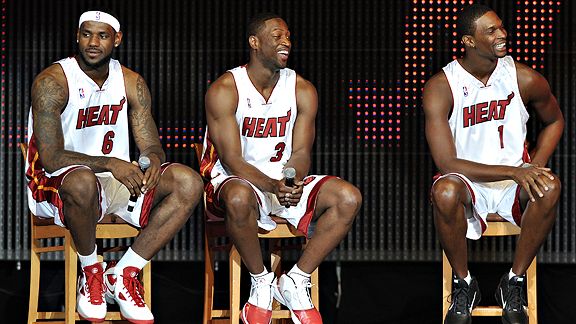
The Big Three won last night on NBA Opening Night, but probably not The Big Three that you're thinking of. No, not LeBron James, Dwayne Wade and Chris Bosh, instead, Boston's Three Party, Paul Pierce, Ray Allen and Kevin Garnett got their first W. But the most prolific player of the game was not one of those six mentioned above. The game's most valuable player instead, was Celtics point guard Rajon Rondo, who showed everyone last night that he was the heart and soul of this Celtics team with his astounding 17 assists.
The hype was there, in fact, it was the most anticipated opening game in NBA history, but the talent wasn't. In the first quarter, arguably the two best teams in the Eastern Conference played like they were back in middle school, with the Celtics only up 15-9 after the first 12 minutes of play. Rondo was the only player who showed any promise at all in the first quarter and even the first half, serving as the engine that kept the Celtics offense moving. Shaquille O'Neal also launched a Shaq Attack early, throwing down two slams in the first quarter to help get the Celts started and even made two consecutive free throws late in the second quarter, a rarity for the big man.
The Heat on the other hand didn't have anything going for them early. They came out looking as if they expected everything to gel right away but didn't know how to make it work yet. Dwyane Wade was playing for the first time since he pulled his hamstring in the Heat's first preseason game and it showed as he shot a dismal 4-for-16 from the field. He played very erratically, not exactly knowing where to be on the floor with LeBron taking over the role of floor general that he has played his entire career. He and LeBron both struggled communicating however, combining for 14 turnovers over the course of the game.
Although it looked as if LeBron had made a huge mistake by taking his talents to South Beach in the first half, that quickly changed once the second half began. With Wade and Bosh on the bench, LeBron was able to get back to the way he played in Cleveland and keep the ball in his hands, which is how he seems to be most effective. It's great that he scored 31 points that way, but the negative side is that he may not be able to play well off of the ball. Throughout his basketball career, James has always been the guy with the ball and the de facto point guard, and now with two other stars who are used to having the ball in their hands as well, it'll be interesting to see how LeBron James is able to play the supporting role during the game, for the first time in his life.
Then there's Chris Bosh. Where does he fit in in all of this? He quietly went 3 for 11 on the night, but managed to pull down eight rebounds. Bosh, a finesse big man, will have a much tougher time fitting in on this team than anyone else. He has about as little power as a power forward can have, and it's even worse when he finds himself playing center. That means that he needs the ball in his hands to be effective more than a usual, powerful big man does, which won't happen with only one ball on the floor and LeBron and D-Wade being the two best players on the team. He'll need to be pulling down even more offensive rebounds than he does now if he wants to score some points. Another problem is that Bosh isn't strong enough to go up against the likes of Dwight Howard and Shaquille O'Neal, the two big men on the other two best teams in the east. Bosh is going from being the best player on a terrible team to being the third best player on what is supposed to be one of the most talented teams ever assembled, and it's going to be interesting to see how he'll handle the change; if it doesn't go well, the Heat may have to change their nickname from the "Big Three" to the "Big Two and The Other Guy."
Then there's the team playing as a unit. Last night, when all three players were on the floor at the same time, it looked like they were each taking turns making plays. One possession it would be LeBron's turn to do something, the next it would be Wade's, then Bosh's then again and again. In order for this team to be effective, they're going to have to learn how to move off the ball, something that none of them have much experience with. But that comes with time and experience as a team, and there's still a lot of both to be had.
The Heat aren't going 82-0, not this year at least. As LeBron James said somewhat arrogantly, "we all know Rome wasn't built in one day." A bit cocky, but he's probably right, this experiment will work out. There's too much talent and young talent at that, for it not to work. It'll take time for everyone to get used to playing with one another, but team chemistry will develop. There's still 81 games left, and in this team's first game against the reigning Eastern Conference champs, and almost reigning NBA champs - albeit that the Celtics did not play as such in this game - they only lost by eight points. Considering the circumstances and the way the played in the first half, the Heat should almost be happy with the outcome; eight points can come very easily as Knicks fans know (http://www.youtube.com/watch?v=nieBAq8FQYE&feature=related, seeing that never gets easier). It'll be interesting to see how everything comes into place for this Heat squad, but one thing's for sure, it will come into place, or else someone's gonna have some explaining to do.
Wednesday, October 6, 2010
Title IX’s Beneficial Intent Becoming Discriminatory

My beef this week is with the discrimination against males in intercollegiate athletics that Title IX has caused.
No, this isn’t an anti-feminist stand; Title IX has done great, necessary things for women’s sports. The problem is, this success has created inequality — exactly what Title IX is supposed to be getting rid of.
Most people are very familiar with Title IX, but few are familiar with its history. Title IX was enacted on June 23, 1972, and is part of the Education Amendments of 1972. The original law states that, “No person in the United States shall, on the basis of sex, be excluded from participation in, be denied the benefits of, or be subjected to discrimination under any education program or activity receiving Federal financial assistance.”
There is never any mention of sports in this original statute. Only after the original statute and after the Department of Health, Education and Welfare got involved did intercollegiate sports become affected by Title IX.
A few years after its inception, under the Carter administration in 1979, the Department of Health, Education and Welfare further specified what they would recognize as compliance with the law. This test is made up of three parts (only one of which schools have to follow), and is often referred to as the proportionality test. The test states that schools in compliance must either “have the same proportion of girls in sports as enrolled in school; [be] expanding the opportunities for girls in sports; or [be] satisfying the entire interest of girls to participate in sports.”
Since the last two are vague, to be safe, many schools just follow the first rule of compliance and try to keep the proportion of female athletes equal to the proportion of female students at the school.
The proportionality test seemed like a great idea at the time. The late 1970s and early ’80s saw equal enrollment between males and females, but that didn’t last as women have since outnumbered men. According to the American Council on Education, females have consistently made up around 57 percent of enrollments at American colleges since 2000. That means that under the proportionality rule, 57 percent of college athletes should be female.
Doesn’t sound very equal to me.
Many critics of Title IX propose that the number of men’s and women’s sports and athletes be based on the interest of each sex to participate in varsity athletics. They argue that interest should be based on participation in specific sports on the club and intramural level, as well as the number of students interested in trying out and the level of interest among high schoolers who hope to participate on collegiate varsity teams. One problem with this is that it would result in more male than female sports teams. In 2009-2010, according to the National Federation of State High Schools, 4,455,740 boys participated in high school athletics as opposed to 3,172,637 girls.
There’s an even bigger discrepancy concerning participation in intramural sports in college where men outnumber women four to one. Although the difference in the number of male and female athletes seems large, it’s a lot smaller than what it has been in decades past, showing that Title IX is doing its job in promoting female participation in athletics. Basing the number of sports teams per gender off of interest would stunt this growth too much for it to be a viable option.
Many proponents of Title IX point to the gargantuan amount of funding that goes to football and men’s basketball teams as the main problem for a lack of funding for small-scale men’s sports, not Title IX.
The first problem with this argument is that the reason most men’s sports are being cut is not because of a lack of funding, but because of the need to comply with Title IX’s proportionality test.
One great example of this is the Marquette University wrestling team. In 2001, the team was dropped despite the fact that it was completely financed by alumni and other program supporters. It wasn’t even competing for funding with a football team, something Marquette still doesn’t have. The only reason was to comply with Title IX.
The majority of men’s teams being cut are usually ones with few if any scholarships, ones funded without the school’s money (or very little of it) and ones that have no big-time football or basketball team to compete with for money.
The second problem with the argument citing high funding for football and men’s basketball as the main problem for the destruction of small-scale men’s sports is that in cutting down funding for these revenue-producing sports, the institution is biting the hand that feeds it and cutting down on the profits that these sports make — profits used to fund small-scale sports. If a school was to cut down funding for popular sports, the talent that these teams would be able to recruit would go down dramatically.
If recruiting plummets, the team falls on hard times and interest among fans drops, resulting in a drop of revenue and profits that the team produces. Since those profits are usually used to help finance other sports, a decrease in them would result in smaller sports getting cut. More funding for football and men’s basketball teams therefore, doesn’t cut down the funding for other men’s sports — it increases it.
The solution to the problem of Title IX is quite simple. Instead of proportionality, colleges should have to have an equal amount of male and female teams and/or athletes. That way everyone gets an equal shot at participating. Another good idea that’s been bounced around is discounting students ages 25 and older in proportionality tests. This age group, which makes up around 40 percent of the undergraduate population, will most likely not be partaking in varsity sports, and therefore shouldn’t be counted in these tests. This would be extremely important, as the American Council of Education’s report “Gender Equity in Higher Education: 2010” showed that female college students ages 25 and over outnumber male college students of the same age group, two to one. Implementing either or both of the systems would be a great way to reform Title IX.
Title IX has done great things and is still vital to increasing female interest in sports to this day. But advocates of Title IX are as stubborn as ever, unwilling to budge in fear that all of the battles they have won over the years will be for naught if they give in even the slightest bit.
The fact of that matter is though, that reform is necessary, and if Title IX advocates truly believed in equality — as they claim — they’d be open to it.
Originally appeared in The Hoya on 10/1/2010
Subscribe to:
Posts (Atom)