Wednesday, March 24, 2010

Shut Up and Sit Down


My beef this week is with Wizards big man Andray Blatche. Blatche, like a sizable amount of other athletes, is an entitled bum.

Last night, in a game against the Bobcats, Blatche was pulled by Wizards coach Flip Saunders for "not getting back on defense."

When Saunders tried to speak with him about his play, Blatche "didn't want to hear it" according to Saunders. Over the course of the game, the coach sent several assistant coaches to talk with Blatche, who still refused to go back in the game. The Wizards, who had lost their previous 11 games, went in to overtime with the Bobcats, but eventually lost 95-86. Who knows what type of effect Blatche, who is averaging 12.6 points and 6.7 rebounds this year and already had 4 points in 7 minutes, could have had on a game that the Wizards desperately needed to win to break their slump?

Blatche has a somewhat successful history on the court. The 23 year old went straight from high school to the NBA, and was drafted in 2005 by the Wizards with the 49th overall pick.

Blatche's playing time and statistics have increased significantly throughout his career, going from averaging 6 minutes and 2.2 points per game his rookie year to 25.9 minutes and 12.6 points per game this year.

Despite his success on the court, Blatche's history off of it is appalling. Blatche has had a few run-ins with the law during his short tenure in the NBA. The first came on August 2, 2007, when he was charged with sexual solicitation. Charges were dropped after he attended a court-ordered day-long seminar for men who solicit prostitutes.

Then, Blatche was arrested on June 4, 2008, for reckless driving, going 86 mph in a 70 mph zone, and driving on a suspended license for not the first, the second, but the third time. He was later released on bond.

This year, he was fined $10,000 by the NBA for participating in Arenas' gun-filled tomfoolery before a 76ers game.

Then there is Blatche's work ethic. Mike Wilbon of the Washington Post and ESPN, says Blatche has an "incredible skill set" but has heard Blatche's Wizard teammates say that he was the "laziest player they 'd ever seen."

This guy has probably been babied his whole life. He has always been the best player on his team, even at his private boarding high school. Like many other players of his caliber he was probably good enough to skip practice and not listen to a word his coach said, all without punishment.

Since he never went to college, Blatche had to quickly make the transformation from the beloved, popular star, to the rookie riding the bench. He went immediately from having more power than his coach to having to listen to his coach or else not play.

His probable lifelong special treatment is why even a day after the incident, he said that he only takes the blame for "25 percent" of the situation. No matter what he has ever done or said, no one has ever sat him down and punished him effectively. Even now, Blatche is not being taught a lesson. By starting him tonight against the Pacers, the Wizards are babying him just like he has been throughout his life. Even after refusing to fully admit his wrongs, he is not being punished. He went on to say the Saunders "needs to apologize, because [Saunders] was wrong" about Blatche refusing to play.

Imagine an employee who does not put much effort into their work, but works somewhat well nevertheless, going into their employer's office demanding a raise. That is exactly what Blatche did when he refused to go back into the game. He cannot expect Saunders to play him more if he does not put in the effort. And if he does not like it? Too bad; he is an expendable employee, and if he is going to whine, then fire him, just like any employer in their right mind would do. Athletes are not babies and should not be treated as so.

He's not Kobe or Lebron, he's Andray Blatche, and whatever the coach says, he should do, and be proud he is still playing professional basketball with his poor behavior and work ethic.

Whether Blatche or Saunders is telling the truth, the fact is that at the very least, Blatche came to the bench after playing unmotivated defense, and when Saunders tried to talk to him, he walked right past him. An employee not listening to their boss, when they are trying to instruct them is unacceptable. The Wizards are an awful team already, the last thing they need is an awful teammate.

Too many athletes today are drama queens and prima donnas. They grow up being the star everywhere they go, and being able to do whatever they please because of their athletic abilities. Then when athletes go straight from being "that guy" in high school to becoming no-names in the pros, they do not know how to handle it, and therefore they do what they know best: pout and whine. Whether it's LeBron James or the worst player in the NBA, no player has the right to override and talk back to their coach. If players like Blatche have shown time and time again that they are unwilling to commit themselves to their team, they should be shown the door, because as much as talent matters, team chemistry matters just as much. And whether Blatche believes it or not, as a mediocre basketball player, there is more where he came from.

Monday, March 22, 2010

The Hometown Hero's Staying Put


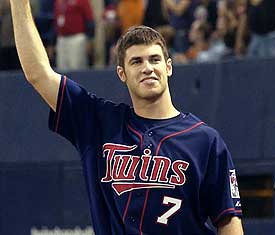
A boy grows up playing baseball, pretending that each simple game of catch in his backyard is like Game 7 of the World Series. The boy eventually grows up. He is drafted as the first overall pick by the team he grew up rooting for, and becomes one of the best players in baseball and subsequently, the hometown hero, living out his dreams. Sounds like a bedtime story from your childhood doesn't it? But really, it's just Joe Mauer's life.

Sunday night, Joe Mauer signed an eight-year, $184 million deal with the Minnesota Twins, a deal that will make him $23 million a year. Only two players in the history of baseball, Alex Rodriguez and Derek Jeter, have inked bigger deals - both with the in-their-own-league-market Yankees - than what the small-market Twins signed their homegrown catcher to the other day.

The only players to ever have higher average annual salaries than Mauer are Roger Clemens and Alex Rodriguez, both deals coming with the Yanks. Mauer's $23 million is tied with the current average salary that C.C. Sabathia is also currently getting from the Bronx Bombers.

The Twins are almost the exact opposite of the Yankees. The Twins had the 24th highest payroll in the league in 2009 at $65,299,267, while the Yankees, as they usually do, topped the charts with a $201,449,489 payroll. The reason I show this is not to hate on my beloved Yankees, but to show how much the small market Twins needed Mauer; so much so they signed him to a Yankee-size deal, which would have been more the one-third of their payroll from last year.

Who knows how much Mauer could have gotten had he tested the free agency market. He probably could have sat back in his recliner and allowed the Yankees and Red Sox to fight over him had he wanted to. But that's not Joe Mauer, and that is why his agent is not Scott Boras, who I'm sure almost had a heart attack when he saw Mauer signed for less than what he could have gotten. Instead he has Ron Shapiro, a well respected agent who has represented the likes of Cal Ripken, Jr. and Kirby Puckett, both of whom stayed with their respective teams for their entire careers.

There is nothing wrong with following the money; it is something you can never have enough of. But by sacrificing millions to stay with one team, his hometown team, Mauer is doing something that has rarely been seen in the uncapped-sport of baseball since free agency was established after the 1976 season. Sure, there are guys like Derek Jeter and Mariano Rivera who have stayed with one team for their entire career, but those two played with who else? The New York Yankees, who could always afford them. Mauer is sticking with a small-market team who is paying him less money than he could get elsewhere.

Usually when a star outgrows their small-town team, they move onto the the big money offered by the Goliaths of baseball; David never wins when it comes to business, especially in sports. But the quiet, reserved AL MVP is not going anywhere; he is following his childhood dream of playing for the Twins.

The deal works out for both sides. Even though Mauer could have made a little more had he tested the market, he gets to stay in his hometown, and is respected everywhere for not selling out to the money. Plus, he is so loved in Minnesota, that he could probably run for governor of the state and win in a landslide. In a huge city, he would just be another star athlete, subject to harsh criticism by media outlets, out of his comfort zone, and never able to shake off the unwanted persona of the country boy in the big city. And, even though he could have possibly signed with another team for close to $30 million a year, $23 million is nothing to look the other way about.

The Twins need Mauer more than he needs them though. Had they not forked over the big bucks, and Mauer had left, Twins fans would have gone into total rebellion, the last thing a team wants when it is moving into a new stadium. Having the homegrown star on the team, increases total revenue dramatically; whether it is in ticket sales, memorabilia sales, or from televising games. The Twins are also contenders for the playoffs every year, and Mauer is a big part of that winning formula. Without him behind and at the plate it is safe to say that they would be relegated to at least the middle of their division. The Twins are making a profit off of Joe Mauer's presence; not paying him the $23 million, could have cost the team a lot more money.

Minnesota's Golden Boy is staying at home. He is passing up fame, riches, and endorsement deals for relative obscurity, despite the fact that he is arguably the best player in baseball. Whether it is because he does not like the spotlight, or just likes the feel of home, one thing is for certain: despite all of the Cinderellas that we have seen this March in college basketball, Joe Mauer signing a long-term deal with the Twins, may be the best fairy tale out there.

Criticism of Big Hits Threatens an Integral Part of Hockey


My beef this week is with the critics of the big hits that have taken place the last week in the NHL.

Although there has been an epidemic of rough hits over the past week, people have to remember that hockey is a rough sport, which is exactly what a lot of fans love about it.

The question here, however, is were the hits dirty plays?

The hit that started all the controversy was the one placed on Boston Bruin Marc Savard's head by Pittsburgh Penguin defenseman Matt Cooke's shoulder, which left Savard with a concussion. Firstly, the NHL rules allow a player to make a shoulder-to-head hit, so Cooke's hit was perfectly legal. Secondly, Cooke had already prepared his check before Savard shot, and when he made the hit Savard's head was down. As a hockey player, one of the first things you learn about checking is to finish your check, and that is exactly what Cooke was doing.

Hockey is not a gentleman's game. Players are expected to do whatever it takes to win the game without overstepping the boundaries that both the written and unwritten rules impose. Cooke followed the written rules by making a legal hit and followed the unwritten rules by not having the intent to injure Savard.

The next hit involved one of the two biggest stars in the sport: Washington Capital Alexander Ovechkin and Chicago Blackhawk Brian Campbell. Ovechkin checked Campbell into the boards, resulting in a broken collarbone that will keep Campbell from playing for seven to eight weeks.

Ovechkin has often been called out for being reckless on the ice, especially when it comes to his hits. But isn't that what people love about hockey? Hockey's violence is what sets it apart from other mainstream sports, and it puts people in the seats.

Ovechkin got a five-minute major for boarding, and a two-game suspension.

It is understandable that the NHL has a PR obligation to show it does not take injurious hits lightly, but the criticism from fans and the media is absurd. Ovechkin was playing the game with intensity, something other athletes don't do enough.

The hits that disturbed me were Steve Downie's hit on Sidney Crosby and James Wisniewski's hit on Brent Seabrook. This is because both Downie and Wisniewski went out of their way to deliver the hits to players who did not even have the puck.

The first took place in a game between the Lightning and Penguins. Downie's hit was clearly meant to injure Crosby. Downie put his knee behind Crosby's leg and bascially tried to snap it backwards.

There was no penalty called, but Downie was later fined the small amount of $1,000.

Then came Wisniewski's hit on Seabrook. Seconds earlier, the Blackhawks' Seabrook had delivered a huge hit to Corey Perry, and the Ducks' Wisniewski felt the need to return the favor. When he made the hit, he left his feet, showing obvious ill intent, and he left Seabrook with a concussion. Wisniewski was hit with an eight-game suspension.

The checks delivered by Downie and Wisniewski are the worst type of hits in hockey because the victims of these checks don't even know what hit them until it is too late. Instead of making violent hits on unsuspecting opponents, Downie and Wisniewski should learn to follow the time-honored saying, "fight like a man." Although fighting may not be the greatest aspect of the sport, at least there is less chance of injury, as both players know what is coming, plus there is still a chance for retaliation, a tradition in hockey.

On the other hand, it would be wrong to say that Cooke and Ovechkin didn't have any malicious intent in making their hits, but neither had the intent to injure anyone.

Hockey is naturally a violent game and almost everyone wants it to stay that way. ESPN analyst Barry Melrose recently appeared on Pardon the Interruption and vehemently defended the physicality of the game, saying, "Hockey is a violent sport. I don't want to get to the point where cowards can play our sport."

Everyone who loves hockey also either loves or respects big hits. They're part of the game. But then whenever someone gets injured, either by a clean play or a dirty play, everyone goes up in arms about the sport being too violent, and suddenly every injurious hit is seen as a dirty play.

This is not true. The NHL allows a lot of surprising things, such as shoulder shots to the head that sometimes result in injuries. So, until the NHL changes those rules, the players have the right to make those hits.

So don't let a few bad apples like Downie and Wisniewski, who don't follow those rules, ruin hockey. The sport has violence in its blood, and big hits are what make hockey, well, hockey.

Special thanks to Brian Ruggiero; without his imparting of hockey knowledge, this article would not have been possible.

Originally appeared on www.thehoya.com on 3/21/2010

Friday, March 19, 2010

March Madness Is Perfect As Is


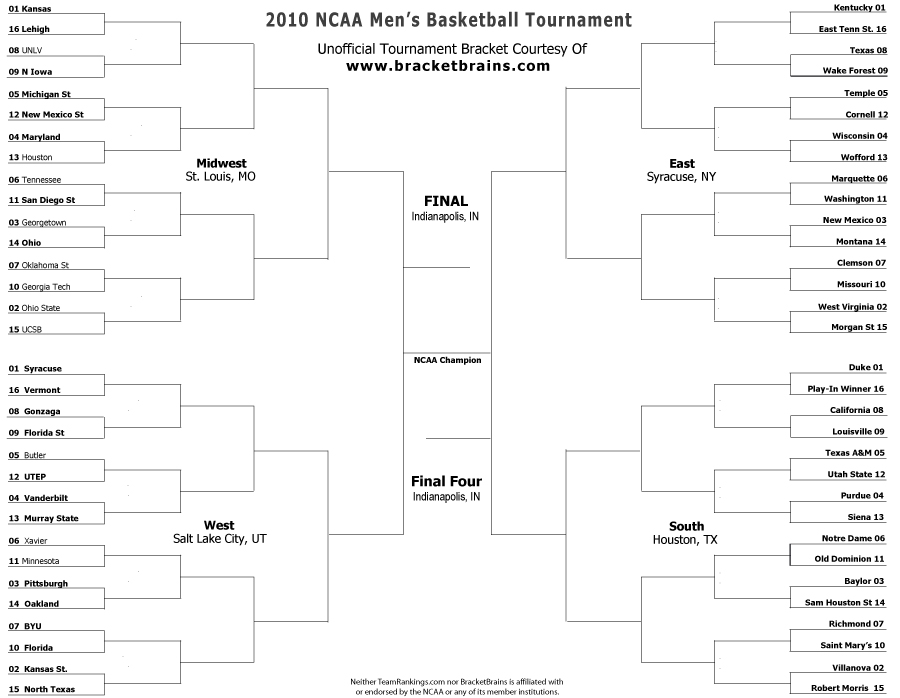
Sorry for the lack of beef intake lately for you readers out there, I guess I have just been a joyous mood with March Madness upon us. I hope you found another source of protein in the meantime. But not to worry, the beef is back and today it is with the proposal of expanding the NCAA Basketball Tournament to 96 teams from its current 65 teams.

The 65 team tournament has been in place since 2001, when one team was added to the tournament to participate in an opening-round game with the 64th team. The tournament however, has had 64 teams since 1985, and has expanded a grand total of nine times since its original inception, starting with eight teams in 1939, and growing from there.

The tournament has grown alongside NCAA Division I, which now houses 347 teams. But is it really time for another expansion?

Coaches and NCAA officials who are calling for the expansion, mostly say that it would give teams from smaller conferences a better shot at the tournament, but what this decision really comes down to is one thing: money.

The NCAA currently has an 11 year, $6 billion contract with CBS that runs through 2013. But after this tournament, the NCAA can choose to opt out of the contract if it wishes to do so. In this economy, it is tough to tell whether the NCAA would opt out of a deal that is making them around $545 million a year; the only incentive to do so would be if they could make more money by having more games.

The 96 team tournament would mean 31 more games, mostly coming in the form of play-in games, and would mean a lot more money for the NCAA from networks wanting to broadcast these games. But the NCAA would not be the only one making a profit off this expansion; the coaches would be as well.

The chances of making the tournament would dramatically increase, as the percentage of teams with the opportunity to go dancing would go from 18.73% to 27.67%. Coaches who make the tournament will look good, and not only have more job security, but will also have a few more zeroes at the end of their paycheck.

So no one loses out, everyone makes a profit, no harm, no foul, right? Wrong. The NCAA seems to forget that the term for athletes in college is "student-athlete." Being a student means attending class (for some people at least), and with the expansion, these players would have to miss an extra week of classes, one of the reasons the NCAA has cited for not creating a playoff system in football. But the real reason is money, and the bowl system in college football and the the tournament expansion in basketball, are the best ways to make that.

Then there is the actual integrity of the tournament. The NCAA Basketball Tournament is one of the greatest events in sports. Every year there are few complaints about teams that got snubbed, but anytime you have something that leaves people out, someone is bound to complain. Plus, there are only complaints about several teams, not thirty-four.

The importance of the regular season and conference tournaments would also be threatened. No longer would small-conference teams necessarily have to win their conference tournaments to make it to the NCAA tournament.

Big conference teams also would not have to play up to the same caliber as they do in the current system. Teams in conferences such as the Big East, with tough schedules, could have .500 seasons, and still make a 96 team tournament. Teams should get a chance at the national title for being excellent, not average.

Jay Mariotti said it best, stating that the tournament expansion would result in "bloated mediocrity." This is portrayed perfectly in the Washington Post. According to the Post, a 96 team tournament this year would probably add additional play-in games like Texas-El Paso vs. Lehigh and Dayton vs. Sam Houston State. Not the most appealing participants.

The NCAA tournament is already 3 weeks long, which seems to be the perfect length. The expansion would make the tournament a month long, and as a result the "madness" of many viewers may fade by the time the championship game hits.

Viewers can only be on the edge of their seat, and maintain a high level of interest in an event for so long, before it starts to get old. When it comes to the NCAA tournament, it is possible to have too much of a good thing.

The NCAA tournament is perfect the way it is. Every game features at least one team that is worth watching, and most teams are good enough to have at least some chance to advance deep into the tournament. The only people who seem to be calling for the change are the coaches and officials who can profit off of it, while viewers have shown only absolute love for the tournament, just the way it is. Hey, if it ain't broke, don't fix it.

Tuesday, March 16, 2010

Woods To Return To Golf At The Masters


There are very few things that can overshadow an event like March Madness, even if it is just for a moment. One of those things is the return of one of the most dominant athletes ever to the sport that has been dying to have him back: Tiger Woods' return to golf.

It seems like yesterday that Woods crashed his car into a tree outside his home, and the previously squeaky-clean, private golfer was thrust into the spotlight. His biggest problem went from throwing the occasional temper tantrum on the golf course, to being on the cover of the New York Post a grand total of 20 straight days, beating out 9/11 for the most covers in a row by any person or event, and having to look on as his mistresses were revealed, one after the other.

After a separation from his wife, a stint in rehab, a public apology, and a four month hiatus, Woods is coming back to golf, on April 8, on the sport's biggest stage: The Masters, which is both a good and bad thing for Tiger.

The decision to make a return at the Masters has a lot of advantages for Tiger. The biggest advantage is that Augusta is his home away from home. He won his first major there in 1997, and has won there a total of four times in his career.

The Masters is known for protecting its golfers from the media and fans. Media credentials are heavily limited, and fans risk being banned for life if they violate the Masters' strict rules. As a result, Tiger will probably only have to field golf-related questions at press conferences, and should receive little to no heckling during play.

Another advantage is that The Masters is golf's biggest event, and Tiger is known for his clutch play. Winning such a prestigious tournament after such an emotionally tough part in Woods' life would allow him to show the other golfers that he is still the same old Tiger, still able to dominate, still able to win every tournament out there.

The eminence of the event can also be a bad thing for Woods. The best of the best will be competing in the tournament, and even though Tiger left the game on top, it is tough to know whether he will be able to play as well as he did before his troubles. Hitting golf balls at his home in Orlando is one thing, but competing in the biggest golf tournament in the world is another.

If he performs poorly, the media, other golfers, and fans will begin to question if Tiger will ever be able play like the Tiger of old. Even worse, Tiger himself may question his own ability to play the sport he has dominated for such a long time.

If Woods is his usual robotic self he should not have too many problems. He knows himself well enough to know when he is ready to play. Woods has always been known as one of the hardest working athletes around, so one has to assume he has been preparing for this moment arduously for the past couple of months. If he is confident enough to make his return at The Masters, he must be ready to play.

Woods is not the first start athlete to have to come back from a major scandal. Kobe Bryant's 2003 adulterous scandal with a hotel employee in Colorado has been mostly forgotten about. Alex Rodriguez had a punishing start to 2009 after admitting steroid use, but his wonderful performance in the 2009 playoffs and his first World Series win has helped him put that in the past. These two are some of the best athletes in their respective sport, and even though Tiger's problems may be larger than theirs', he will eventually be forgiven, and should be able to come back and play as well as before the scandal, if not better.

The United States is a forgiving country, especially when it comes to forgiving celebrities. A win in the Masters for Tiger would put him back on top of the world, as almost everyone, from golf zealots to teenage girls will probably watch at least one round of Tiger's return to golf.

Tiger Woods was the greatest golfer and arguably the greatest athlete in the world not so long ago. For the past four months he has been the subject of the greatest tabloid story ever. Now it's time for Tiger to make the greatest comeback ever.

Monday, March 15, 2010

LT Ready To Help Jets


Remember those awful Jets' teams of the 1990s and even worse, the average Jets' teams of the 2000s? Well, the New York Jets took a step in avoiding ever being those types of teams again with the addition of running back LaDainian Tomlinson.

The Jets have a history as one of the most disappointing franchises in sports. Bill Simmons of ESPN recently ranked them the 11th most torturous team in all of professional sports. They have not won a Super Bowl since 1968, and usually break the hearts of their fans by starting hot and falling apart at the end of the season.

During the 2000s the Jets were the definition of mediocrity. With quarterback Chad Pennington at the helm, fans figured that his high quarterback rating and pinpoint accuracy would translate into playoff wins, and it did to a certain extent, as the Jets made the playoffs three times during his time there, winning two playoff games. But the Jets organization soon realized that with a quarterback that had the arm of an eighth-grader and the fragility of a glass vase, they could never be a Super Bowl contender.

Then arguably the second most important day in Jets history took place (only behind January 12, 1969, the day the Jets won their only Super Bowl). On August 7, 2008 the New York Jets signed superstar Brett Favre.

Brett Favre was the biggest name the Jets had had since Broadway Joe Namath was quarterback. In an instant, the Jets went from being the second most popular football team in their own city to making headlines all over the sports world. With the switch from the average, weak-armed, quiet Pennington, to the strong-armed, free-wheeling, headline-making Favre, the Jets quickly became a team to beat in the AFC.

The honeymoon ended quickly though. After starting 8-3, the Jets finished 9-7 and narrowly missed the playoffs, mostly due to the incompetency of their coach "Mangenius" and the implosion of the aging star Favre.

Despite the fact that Favre's stay in New York did not pan out so well, it put the usually boring Jets on the map. Instead of having players like country boy Chad Pennington and a coach like the reserved Eric Mangini the Jets drafted the California kid Mark Sanchez and hired the boisterous Rex Ryan as their coach. Favre may have not gotten the Jets to the playoffs, but he did bring them star power, and since his arrival the Jets have been all about getting the big names in the league including the likes of Bart Scott, Braylon Edwards, Antonio Cromatie.

Yesterday, the Jets added on to that list of big names, with the addition of superstar LaDainian Tomlinson. The addition of Tomlinson comes with the departure of Thomas Jones, who rushed for over 1,400 yards last season. Jones is a better back than the Tomlinson, who rushed for just 730 yards last year, but the statistics do not tell the whole story.

The departure of Jones, opens up things for prodigy Shonn Greene, going into his second year, after some wonderful running in the playoffs of his rookie season. It does cost the Jets money however, as the Jets paid Tomlinson, now under a 2 year, $5.2 million contract, $100,000 more than Jones got with the Chiefs. The extra pay seems like it will be worth it. The Jets' two relatively young running backs Greene (24) and Leon Washington (27), have the opportunity to learn a thing or two from one of the greatest backs of all time in Tomlinson, who ranks third on the all-time touchdown list among running backs and wide receivers, and eighth on the all-time rushing list.

The Jets are poised to make another run deep into the playoffs this year. With the addition of Antonio Cromartie, one of the best defenses, if not the best defense in the league gets better, despite the loss of Kerry Rhodes. The young guys on offense such as Sanchez, Greene and Keller now have some more experience under their belt, and the addition of Tomlinson adds some leadership to the group. With one of the best offensive lines in the league totally intact from last year, the offense will be as good, if not better this year, despite the loss of Thomas Jones. The Jets, one game away from the Super Bowl last season, are looking stronger and better than they have in a long time.

Tomlinson will most likely split time with Washington on the runs to the outside, while Greene will be doing most of the running up the middle. Tomlinson is a smart guy; he knows that his role will be limited in terms of playing time, despite a well-paying contract, but his job in teaching Greene and providing the Jets with one of the most popular players in the game will be priceless.

Sunday, March 14, 2010

Social Media Harm The Sports World


My beef this week is with the growing relationship between sports and social media.

For the past couple of years, both professional and collegiate athletes have used social media sites such as Twitter and Facebook to have a closer connection to their fans and essentially use them as a platform to say what they want to say — whether it be talking about that great pancake breakfast they had this morning or trying to help with the relief effort in Haiti.

Athletes usually use Twitter pages in a playful way, to create a personal brand and to remain popular among sports fans willing to follow their every move.

But sometimes, these athletes cross the line and expose a little more than they should in their tweets or Facebook posts.

Just this past week, Julian Wright of the New Orleans Hornets used Twitter to tell his 5,220 followers that he “might need a change of scenery.” He did this before speaking with anyone in the Hornets organization about wanting to be traded.

Problems with athletes exposing too much information on social media sites do not just extend to professional athletes and Twitter; the same problem can be found with collegiate athletes and Facebook.

Another incident occurred this past week when Oregon wide receiver Jamere Holland used an expletive-filled status update to express his anger over the dismissal of fellow Duck Kiko Alonso from the team after he was arrested for a DUI.

The Facebook post read: “How the (expletive) you kick kinko off the team … on some weak (expletive) he slipped up but ive been slippn up, and I’m still here, that (expletive) ... could have done damage for the ducks, that (expletive) is weak, weak (expletive), quote me.”

Well, he certainly got that wish. His words spread quickly, and soon enough Oregon Head Coach Chip Kelly decided to kick Holland off the team for a violation of team rules.

Holland and Wright are far from the only athletes who have run into trouble for their Twitter and Facebook posts. Inappropriate comments both in terms of content and timing by athletes on these sites have become headaches for league and team management. NBA players like Shaquille O’Neal and Charlie Villanueva have actually tweeted during the middle of games, and before Chad Ochocinco had the chance to do the same, the NFL shut him down.

Possibly the worst aspect of athletes using social media is the fact that sometimes the athletes leak information to the public that the front office does not want made public.

Last year, Minnesota Timberwolves’ forward-center Kevin Love told the world that his coach, Kevin McHale, would not be returning this season — before anyone else in the front office or McHale himself got to make the announcement.

As a result of these incidents, executives have to be careful about how they handle athletes’ use of social media sites and how much leeway they give them.

But not all uses of these sites by athletes are bad. The advantages of athletes using social media are numerous, not only for the athletes but also for the team.

By becoming a follower of an athlete, a person is more likely to closely follow that athlete, which means they are more likely to follow the athlete’s team and the league in which the team plays. Everybody wins.

Aside from these advantages, however, there are the numerous disadvantages that come with athletes using social media sites.

Twitter and Facebook are ideal places to vent anger, whether it be about wanting to be traded, not getting enough playing time or how anyone from the front office to the coaching staff to even teammates are handling things.

The process of typing our feelings into a Twitter or Facebook post is so impersonal that it makes it seem that what we are saying is harmless. Yet it is actually very personal, as people around the world can immediately see what you have to say and form their own opinions. A simple expression of emotion can quickly turn into a whirlwind of exposure.

The NBA and NFL have placed restrictions on their athletes, stating that they cannot tweet before, during or after games until they have met with the media.

Even though these restrictions have been helpful, it remains close to impossible to stop problems from arising without totally keeping athletes off social media sites.

It is easy for an athlete to slip up. But these athletes are constantly under the spotlight, and one simple mistake is all they need to suffer dire consequences. Athletes are humans too — they make mistakes like everyone else. They just need to be stopped before doing so on Twitter or Facebook.

Originally appeared in The Hoya 2/26/2010

Tebow's Ad In Wrong Forum


My beef this week is with Tim Tebow’s pro-life advertisement that is supposed to air sometime during the Super Bowl.

Every year, about 100 million people tune in to watch the Super Bowl, usually making it the most watched television event of the year. The game is always a great chance for families and friends to get together and watch the championship game of America’s favorite sport, or for others that are not the biggest football fans, to see some of the most anticipated commercials of the year. Whether someone is male or female, old or young, a Sports Illustrated subscriber or a Cosmopolitan diehard, chances are that this upcoming Sunday, they will be watching the Super Bowl — just like they do every year.
But this year, in addition to seeing some of the hilarious commercials they are used to, they will also see a commercial with a star athlete talking about a serious issue: Tim Tebow speaking on abortion.

Tebow is the former University of Florida quarterback, and he has been America’s golden boy for the past four years. He was born in the Philippines to Christian missionaries Bob and Pam Tebow, and he was homeschooled by his mother all the way through high school. During every game of his college career he wore biblical verses on his eye black. Tebow has even been personally affected by the issue of abortion; before he was born, doctors predicted a stillbirth and recommended that Tim’s mother get an abortion, which, being a devout Christian, she refused to do.

If you haven’t already guessed it, Tim Tebow is pro-life.

The advertisement, paid for by the faith group Focus on the Family, will feature Tebow’s mother speaking about her decision not to have an abortion while her Heisman Trophy-winning son sits at her side. The ad is meant to show women the positive effects of keeping their children, instead of going through with an abortion.

The problem is not the Tebows’ attempt to convince people to be pro-life; rather, it is the circumstances in which they are delivering their message. Players are always criticized for not taking stances on important issues, and when someone like Tebow comes around, it is a breath of fresh air for fans.

The fact that he is so principled at such a young age, and with all of his fame, is amazing. His missionary trips to third world countries, speeches to inmates and community service projects show that Tebow is a caring individual. But for him to come on the air during the Super Bowl as a 22-year-old college kid and talk about one of the most heated topics there is — with almost everyone in the country listening to his every word — is crossing the line.

Another issue with Tebow’s advertisement is the type of commercial it is. Anyone who has watched the Super Bowl knows that most, if not all, of the commercials are humorous. An issue this important should be debated and talked about in a setting that doesn’t occur between commercials featuring talking animals and women getting ready to strip off their clothes for GoDaddy.com.

It is understandable why the Tebows would want to have the advertisement run during the Super Bowl: Their message will reach the biggest audience possible, but that is one of the reasons this commercial should not air this Sunday. In the past, advocacy groups such as PETA and the United Church of Christ looking to air their commercials during the Super Bowl have been turned down by CBS because of their tendency to cause controversy — the last thing people should have to deal with when they are watching a football game.

Sporting events, especially those as big as the Super Bowl, offer a way for people to escape life’s dilemmas, for a little while, with an exciting game and amusing commercials. Running an advertisement talking about an issue as contentious as abortion during the little time we have to get away from controversy ruins one of the beautiful things not just about the Super Bowl but about sports.

Tebow has the right to free speech; he can preach all he wants about his faith, and he is rightfully commended the majority of the time for taking such a strong stance on such an important issue and for having such a strong faith for someone who is so popular at such a young age.

So Tim Tebow, I am not critiquing the biblical verses on your eye black, your trips to jails to spread your faith to inmates who are in desperate need of someone to guide them, or your wonderful community service projects — just keep your message out of the Super Bowl.

Originally appeared in The Hoya 2/5/2010