Friday, May 28, 2010

God The Superfan


Today my beef is with athletes who thank God for their victory, as if Satan himself was backing the opposing team.

Look, I'm a religious guy, but I just can't stand when athletes thank God for winning a game. I just think God should be and is worried more about a few other, more important things in the world like war and hunger rather than whether a team wins a game or if an athlete plays well.

During the past week Dwight Howard and Nate Robinson both thanked God and/or Jesus Christ for their respective victories. When Howard was asked, why people should pick the Magic to beat the Celtics, Howard responded in a one-word answer: "God." After being given a chance to change his statement, Howard didn't alter what he had said, stating, "That's the reason, I'm telling you."

When Robinson was asked about how he had such a big impact on Game 6, he had a similar answer to Howard, saying "God. I mean believe it or not, I'm a big, firm believe in Jesus Christ so he just told me to be patient and wait for my number to be called and be ready to play."

Woah, woah, woah, let me get this straight. I thought God was a Magic fan, according to Dwight Howard. But in Game 6, he and Jesus decided to give the strength to Nate Robinson to be patient and have a monster game. Did God have money on a 4-2 series win for the Celts? Did Jesus bet Peter that Nate was going to go off in Game 6? Was it really the work of God that the Celtics won the series as opposed to the actual talent and determination showed by the players on the court.

Look, if there's one statement here that is more acceptable than the other, it's Robinson's. At least, Robinson claims there was less divine intervention than Howard did. Robinson basically meant, from what I can glean from his statement, that Jesus gave him the patience and the strength to play well. This isn't necessarily too poor of a statement, as he's' not saying Jesus himself was fully responsible for his solid play, but the strength Jesus gave him to work hard and the patience he preached, did. Still, if you're going to give an explanation as to why you played so well, maybe you'd like to mention your teammates, or your own hard work, or your coach for giving you the opportunity before giving thanks to God or Jesus. I'm not saying that your teammates, your coach or even yourself should take precedent over Jesus or God, it's just that those involved with your team probably have more of an impact on the actual game than a deity or a messiah.

Howard's statement however is flat out ridiculous. Really Dwight, God will be the reason that the Magic to win? If I had to guess what teams God would be a fan of, I'm guessing that first place would go to the New Orleans Saints, followed closely by the Los Angeles Angels of Anaheim, and then I'm pretty sure third place would go to the Boston Celtics, with last place of course going to the New Jersey Devils, which is clearly Satan's team. I'm pretty sure the Orlando Magic, would be pretty low on God's list of favorite sports teams as well, tied with the Washington Wizards. Wouldn't wizards, witches, and magic be pretty closely linked to heathenry?

But hey, since the Celtics won, God must have been rooting for the Celtics, and of course God was rooting for the Lakers, a team with an adulterer who has been accused of sexual assault, the guy who married a Kardashian, Ron Artest, who God knows how many sins he's committed, and Pau Gasol, who I'm sure God even hates. Hey, God must be the Buddhist Zen master Phil Jackson's biggest fan.

I don't necessarily have a ton of qualms with players claiming that God or Jesus Christ has taught them the patience they need to succeed, or given them the strength to play well, through their teachings. But to make any claim that even resembles the idea of divine intervention in a game is just preposterous. I just can't picture God and Jesus in their La-Z-Boy recliners with their foam fingers, eating wings, and intervening in the NBA Eastern Conference Finals, as if they actually have a rooting interest.

Thursday, May 27, 2010

There's No Crying In Basketball!


Today, I have a beef, but I'm not sure who to direct it at. I guess I'll just say I have a beef with all the athletes out there who also seem to have a part time job in whining, as well as the league front offices out there that continue to allow this bad behavior and serve as the worst parents in the world to these spoiled brats who are paid millions.

Two nights ago, Kendrick Perkins, of the Boston Celtics, got two technical fouls in Game 5 against the Magic. Perkins has been Dwight Howard's kryptonite for most of the series, as well as one of the most underrated players during these playoffs.

The first technical came when Perkins was helping up teammate Paul Pierce and the Magic's Marcin Gortat got a little bit closer to him than he apparently would have liked. As a result, Perkins gave Gortat a little elbow to the chest. The second technical came when Perkins contested a call made by Ed Rush, one of the most respected referees in the game, by throwing his hands up while looking at Crawford and then walking away shaking his head in disgust.

I realize that maybe these fouls didn't necessarily warrant a technical by usual NBA standards, but I have had enough of the whining that takes place after the referee makes a call across the game of basketball.

Complaining about bad calls is probably more widespread in basketball than in any other sport besides baseball, where yelling at the umpire, kicking dirt on his shoes and throwing little temper tantrums have become time-honored traditions. Heck, Braves manager Bobby Cox has been ejected close to 150 times in his career.

But basketball is different. There's no real precedent set for arguing calls. The usual protocol is that the elite players, veterans and the head coaches, are allowed to make their case through calm conversation during a stoppage of play, such as a free throw or during a timeout. Anything but yelling or throwing your hands in the air will basically keep you from getting a technical.

But, I have had enough of all of it. It has come to the point where almost every single time that the referee makes a call on some of these guys, they throw their hands up in the air, as if there is no possible way that they could have done anything wrong.

Hey, I have a suggestion! If you want to stay out of trouble, try this thing called controlling your anger. I know basketball is an emotional game with its fast pace, and its numerous ups and downs as teams trade baskets back and forth, but it really is not that difficult to keep your emotions in check.

The players aren't the only ones at fault here. The NBA is sending out what I believe to be a wrongful message in rescinding the second of Perkins' technical fouls, and is basically telling players to keep whining and crying not only over questionable calls but all calls made against them. The league usually fines anyone that criticizes the referees after the game, so why are they not cracking down on whining and criticism during the game as well?

No player should be allowed to talk back to the referees. That being said, conversation should be allowed, and is welcomed by all referees. But when a player, especially one like Kendrick Perkins, who has a knack for crying for his mommy over every foul called on him, keeps on whining like an over-privileged, spoiled brat, the NBA should punish him severely. If they don't, then like any actual spoiled, whiny brat, guys like Perkins, will never learn their lesson. If punishing Perkins means keeping him out for a pivotal game in the playoffs, so be it. The situation should not matter, the punishment should always fit the crime, whether it means missing a meaningless exhibition game or Game 6 of a conference finals.

It's not jut role players like Kendrick Perkins that should be punished either. Guys like Kobe Bryant (especially Kobe Bryant), with his famous arm flailing, Dwight Howard with his confused looks and moaning and Josh Smith who not only acts like a baby, but looks somewhat like one too, all of whom are stars in the league, should not have any more protection from technical fouls than anyone else. But no, the league is afraid of the uproar that would result from doing the right thing and giving them their stars the technical fouls that they deserve.

Is it fair that I'm essentially holding basketball to a higher standard than baseball? Maybe so, but that is because of the differences between the two games. In baseball, there are no fouls, just ejections, and therefore if you argue over anything with the umpire, you better get your money's worth as almost any argument will get you thrown out of the game. That's why you see mostly tirades in baseball, instead of the usual conversing with the referees, that you see in basketball. Tirades in baseball are expected and tolerated by the league as long as there is an ejection, while tirades in basketball aren't expected nor have ever been tolerated.

Another difference between the two are the types of calls being argued. In baseball, the calls being argued are usually either absolutely right or absolutely wrong, such as whether a runner was tagged or whether the ball was fair or foul. In basketball, most of the contested calls are fouls, and therefore judgment calls that the referees are paid to make. I realize umpires are paid to make calls in baseball as well, but it's tougher to be wrong about or argue a judgment call that has a vague answer or multiple answers than it is to be wrong about or argue an absolute call that has an absolute answer.

So sure, baseball players certainly should not have any more right to act like a bunch of kindergartners (sorry if I offended any kindergarten readers out there) than basketball players, but there is at least some precedent for it in baseball. If the NBA really wants to protect its referees from criticism, as commissioner David Stern constantly says and shows he wants to do by issuing fines to anyone with anything bad to say about them, then maybe they should show their initiative and tell stars like Kobe and Dwight that if they are not going to talk to the refs like normal adults, then maybe they'd like the view better from the bench in street clothes rather than the court in a jersey.

The Man Under The Mullet


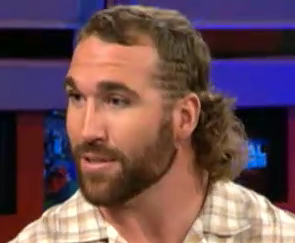
No beef today ladies and gentlemen. Only tears, tears of sadness over the death of something beautiful yet rugged, something stylish yet reportedly past its prime, something almost too wonderful to put into words. The era of the Jared Allen mullet is over, at least temporarily.

Allen claimed on his Twitter site that, "The mullet was trimmed for the wedding but the Moolay is more than just some hair, its a lifestyle! You gotta keep a positive Mullitude...."

Apparently his reportedly camera-shy fiancee, the 24 year old Jordan Parrish, felt it would be best if Allen weren't to rock the mullet for their big day. So, even though some of the devoted followers on his website www.jaredallen69inc.com, and in his "Mullet Militia" may be disappointed, they shouldn't worry, Jared Allen is just as awesome as ever.

Allen has become a Twitter/YouTube/television phenomenon with his numerous antics. Search for Jared Allen on YouTube and you'll find videos upon videos on just about everything from Allen talking about his mullet and heart-shaped chest hair to him hunting in a tree to his sack celebrations and even him running around a grocery store in a turkey costume. It's also no mistake that he wears the number 69, in case you were wondering.

He also just developed an iPhone app that includes things like the history of American flags, a mullet generator which gives you an idea of how you'd look with a mullet, hunting tips, pictures of the mullet militia, Allen's favorite songs, his Twitter page, and information about his restaurants.

Allen has quickly earned a reputation as one of the funniest players in football, but believe it or not, is probably more feared on the field than funny off of it. And for good reason. In the past three seasons, he has put up amazing numbers, posting 15.5 sacks, 14.5 sacks and 14.5 sacks, the first year with the Chiefs and the last two with the Vikings respectively. And don't think those sacks go unrewarded; for each sack Allen puts a racing stripe on the side of his head, and of course earns a good amount of money. The Vikings made Allen the richest defensive player ever at the time in 2008, when they signed him to a six year, $72.36 million deal.

But of course, life for Jared Allen hasn't always come as easy as making quarterbacks cry has. Allen was a no-name coming out of Idaho State, drafted by the Chiefs in the fourth round of the 2004 draft, despite his constant top-notch performance throughout his high school and college careers.

The thing is, he's had more trouble proving his worth off the field than on it. Allen has been arrested/charged for DUI three times. The first came in Pocatello, Idaho on May 11, 2002. The next two came on May 11, 2006 and September 26, 2006, both in Leawood, Kansas, and the latter for which he spent 48 hours in jail.

But since that last incident, Allen has turned his life around. He no longer drinks alcohol, as he claims to have found a new drink of choice in O'Douls, a non-alcoholic beer.
"O'Douls is delicious, it's what beer drinkers drink when beer drinkers can't drink beer."

Allen has also been involved in community service for the past few years. He has worked with the Juvenile Diabetes Research Foundation and was one of four NFL players (the other three being Larry Fitzgerald, Will Witherspoon, and Danny Clark) that went to the Persian Gulf on a week-long NFL-USO tour to visit the troops.

Allen is the type of star that I love, the type who market themselves beautifully, but stay out of trouble and never take themselves too seriously. Allen always seems to be having a good time in whatever he's doing. He never runs his mouth, but he's also not afraid to voice his opinion, or show his energy and emotions on the field. The best part is that the guy can actually play football. Until he was a dominant football player, he made sure to stay quiet for the most part, but now that he is constantly in the football spotlight with his wonderful play, Jared is open to it. He knows how to keep the fans happy and interested both on and off the field, and is having fun and making money at the same time.

Just a few years ago, Allen was virtually an unknown, defensive end who had his fair share of trouble. Now, the born-again jolly, joyous, jovial Jared who doesn't drink alcohol and takes part in community service is one of the best and most popular players in football; let's just hope that his mullet comes back as soon as football season does.

Wednesday, May 26, 2010

A True Scholar Athlete


With an overall lack of interesting stories to write about, I decided that I would choose one that I've been keeping my back pocket for about a week now. Sorry folks, no beef today.

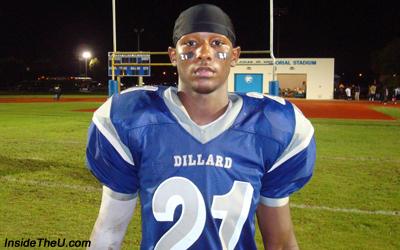
Today, our story brings us to Oakland Park, Florida, to Dillard High School, the place where one of the top safeties in the football recruiting class of 2011, Wayne Lyons, attends school and plays football.

With 44 scholarship offers, some from the likes of powerhouses such as Florida, Alabama, Notre Dame and Ohio State, as well as many other top-notch programs, Lyons certainly has a lot to think about going into his senior year, and of course, like anyone else, he wants to make as informed of a decision as possible.

That's why he has mailed each coach who has sent him scholarship offers a questionnaire with 50 questions. The questionnaire has questions ranging from professor-student ratio to what airport his mother would fly into, if she wanted to come to a home game. Sure, maybe it seems like this is a kid who seems to be a bit cocky, in thinking he's good enough to get the best coaches in college football to answer a questionnaire like this. But if you think that, then you really don't know Wayne Lyons.

Lyons, isn't just another stuck-up, entitled high school football stars that seem to be all too common these days. Lyons puts as much emphasis on the scholar as he does the athlete, in the term scholar-athlete, something which is very rare among players of his caliber. Instead of struggling to get his GPA high enough to actually play football, Lyons is on track to finish as valedictorian of his graduating class, as he currently has a weighted 5.0 GPA. Sadly, guys like Lyons have become the exception instead of the norm.

But that's not all. When he's not making hits on the gridiron, or studying for that matter, Lyons, is working with his school's Hi-Tech Team, which builds robots. This goes hand in hand with the fact that he wants to become an engineering major, and after his playing days, an engineer. It's so important to him that question #37 on his questionnaire asks, How many African-American players have graduated with an engineering degree in the past five years? Year-by-year? Please list their names.

In an interview with ESPN, Lyons said that during the recruiting process, he has learned to "always stay humble, and work hard and it will pay off."

Now, I can see why some would criticize the questionnaire, despite the fact that Lyons and his mother only have good intentions in sending it out to coaches. I'm not sure how he would learn to stay humble from the process, when he is the one expecting coaches to answer his 50 questions. I know coaches go out of their way to woo their recruits, but even this could be considered a bit too much. The huge football programs recruiting Lyons, are also recruiting about everyone else out of the top 150 players in his graduating class. I know every recruit wants to be shown attention. I would hope that a player as smart as Lyons would realize that coaches cannot devote so much time and effort to just to him, and therefore, that he doesn't base his whole decision on the answers to the questionnaire, most of which will probably done by some lowly team manager instead of the actual coach. Instead of relying on the questionnaire, Lyons should do most of his own research, and find out about each school for himself.

That being said, hopefully most coaches and critics will realize how special and unique Wayne Lyons really is, and how if any recruit is worth filling out 50 questions for, it's him.

Tuesday, May 25, 2010

Move Cyclists, Get Out The Way


Today I'd like to stray a bit off of the beaten path, exactly where I think the subject of this article should be placed. I'd like to talk about the two-wheeled mayhem machines that are bicycles. My beef today is with cyclists.

No, not all cyclists, just the ones who are completely oblivious to everything going on around them and think that they own the road. I myself, ride bicycles on occasion, but I do it on back-roads or quiet neighborhoods and stay out of the way of both people and cars. The real problem I have are with cyclists who think that it's OK to bike in the most congested parts of the most congested cities. Or the ones who bike right in the middle of the road, right in front of cars, who despite being fast for cyclists, are very slow compared to cars. Or the ones who fly by on the sidewalks past innocent pedestrians. It's time to take a stand against these chaos creators.

There I was, running along the Potomac River on the side of the road for my first time in my young college career. It was a beautiful sunny day, a strong contingent of runners enjoying their journeys. All of a sudden, three bicycles whizzed right down the middle of the two artificial running lanes that had been created, right by me, almost severing my right arm. The trail runs alongside the Rock Creek and Potomac Parkway, and is used predominantly by runners. But cyclists seem to have taken to the trail and are always weaving in and out of runners at high speeds.

So I decided to take my running to the main roads of DC. It wasn't any better there. Cyclists were staying off sidewalks for the most parts, but instead they were going onto the roads. Now, some of these cyclists could move at impressive speeds but a car that actually has an engine moving it along, instead of a couple of legs and a pair of feet, is the one that should be on the road. As if there wasn't enough traffic in cities, now whenever there is open road it seems as if there is always a cyclist to ruin it.

In 2008, 69% of bicycle accidents were in urban areas, and 64% were at intersections. Many cyclists blame accidents on motorists, saying the majority of accidents result from driver negligence, such as a driver pulling out of their driveway or a parking lot, a driver failing to yield, or a driver under the influence of alcohol, according to ezinearticles.com. Alcohol usage was one of the biggest problems in cycling accidents, being involved in 37% of them in 2008. But the problem isn't just with motorists; 23% of cyclists that were killed were drunk themselves.

In terms of driver negligence, drivers should not be the ones looking carefully around for cyclists every time they drive. Since cyclists are the ones that could actually be hurt by cars and not the other way around, they should also be the ones paying attention, watching and listening for when a car is coming, not the driver. This isn't driver negligence, it's biker negligence.

It's not as if most of the accidents happen with kids who don't know any better either. According to the National Highway Traffic Safety Administration, the average age of bicyclists killed on U.S. roads in 2008 was 41 years old, while the average age of bicyclists injured on U.S. roads was 31 years old. You would think that since kids are much smaller than adults making them less visible to drivers, don't have much experience on the roads as adults, and ride much more often and in greater numbers than driver 's licensed adults, that they would be involved in accidents more often, if these accidents were a result of driver negligence. But what is really happening is that middle aged bikers are going onto dangerous roads, knowing the risks they are taking, knowing the rules of the road, and yet still being overly oblivious.

Biker negligence goes all the way to breaking the number one rule in cycling: wearing a helmet. In 2006, 95& of cycling deaths occurred when bikers were not wearing their helmets, something that only 35% of cyclists 16 and over wear the majority or all of the time, and only 50 % of that same age group wear some of the time.

It's not as if cities are the only place to ride a bicycle. There are parks, trails, even quiet neighborhoods, that are perfect for going for a bike ride, whether it's just for tranquility or for serious exercise. There are also numerous roads with lanes just for cyclists, that work wonderfully. But in 2008, out of people ages 16 and over, only 5% of cycling trips were made in these bike lanes on roads, compared to 48% of trips being made on paved roads, and 14% being made on sidewalks.

I understand that cycling is great for the environment, and I appreciate people trying to go green. I also understand that cities are great environments for everyone from the tourist biker to the serious cyclist to take a ride in; as a runner I find Washington, D.C. the best place on erath to run. But the sidewalk is for people, and the road is for motorists; with bicycling being such an awkward middle ground between the two, it makes perfect sense that bicycle lanes between the road and sidewalk or cycling trails would be perfect for cyclists.

So cyclists, especially you serious ones, this is a message to all of you, a public service announcement of sorts: I drive a dark slate Nissan Altima. If you are cycling in a congested area or neighborhood on the main road, and see a car like that which seems to be speeding up and coming right after you, I suggest you start pedaling very, very quickly.

Monday, May 24, 2010

Tie Goes To The Fielder With No Way To Review It


Today my beef is with the disappearance of the tie goes to the runner rule, as well as the lack of replay for plays other than home runs in baseball.

This is my beef today because, last night in the 9th inning of the Yankees-Mets rubber match, Brett Gardner should have been called safe, as he touched the bag at the same time the ball was caught by Mets first baseman Ike Davis' glove. You can say that I am crying over spilled milk, but over the past few years whenever there is a tie between the runner touching the base and the fielder catching the ball, it seems as if the fielder gets the benefit of the doubt from the umpire more often than not, instead of the runner.

The actual rule (Section 6.05) from which the saying "tie goes to the runner" is derived from, actually states that "A batter is out when after he hits a fair ball, he or first base is tagged before he touches first base." The key word there is before, so therefore it is implied that a tie goes to the runner.

There have been numerous debates over the rule, the first being that you cannot use a rule that does not actually address ties. Maybe they are right, but one thing you can most certainly go off of is precedent, and the clear precedent here is that that the tie goes to the runner, not the fielder.

Another argument is that Section 7.01 states that "A runner acquires the right to an unoccupied base when he touches it before he is out," with many emphasizing the before part. But this argument also does not make much sense, because according to Section 6.05 the runner is not out until "he or first base is tagged before he touches first base." So, since he is not out until he is tagged or until the ball beats him to the bag, he has the right to the unoccupied base.

Then there is Section 7.08 which states "Any runner is out when he fails to reach the next base before a fielder tags him or the base." Yes, I admit this is contradictory to Rule 6.05, because of the emphasis again on the word before. But, I submit to you, once again, the precedent rule. Since Sections 6.05 and 7.08 are in clear contrast with one another, the rule which has been practiced is the one that should win. Since one makes as much sense as the other, this is the only way to decide, and therefore the advantage is to the tie goes to the runner rule.

But enough of the rule jibber-jabber and overly scientific reasoning, my head hurts, and yours probably does too. Do I have much evidence that ties are going more to the fielder than the runner as of late? No, because a tie is totally a judgment call, and for many an impossibility, with the idea that there can never be an "absolute tie." After my usual hours of research on the worldwide web, I found a lot on whether the tie should actually go to the runner or not, but little on whether it actually has in the past few years. So sadly, in this sense, since I have about as much evidence as Floyd Landis has against Lance Armstrong for using steroids, I can only say this as opinion and not fact, and make the mere suggestion to pay attention for the disappearance of the rule.

Having said that, let's move onto my next beef, the lack of replay on close calls other than home runs in baseball. Baseball is the only major sport that has been reluctant to use replay, implementing it on August 28, 2008, 22 years after football first had it, and six years after basketball started using it. So far, the usage of instant replay in baseball, has been sketchy. The umpiring crew chief has to decide whether or not to review the contested play - which can only be a questionable home run - and if he does, the umpires intervene in front of a screen somewhere off the field, for what seems like an eternity and come back with their call.

The first problem is that instant replay can only be used for home runs, which seems a bit ludicrous. The main reason for this, is usually the desire to keep the human element of officiating a game, in baseball. But, the human element allows for error, error which can decide the outcome of everything from a game to a championship, which is unacceptable. Why should a call that's wrong, and could easily be corrected, be allowed to affect the outcome of a game? I just don't see why a tradition of allowing for mistakes should trump installing a new rule of instant replay to get the call right every time, like whether an outfielder actually caught the ball, a runner was safe, etc. I realize that this would elongate the game, a game which many say is long enough already, but that shouldn't stop baseball from using replay more often, it should only encourage them that there needs to be a more efficient way to look at replays, that takes only a minute or two, like the replays in football or basketball do.

The second problem is that the ball is in the crew chief's court (or field in baseball) when it comes to calling for the replay. There are numerous problems with this, the first being that the crew chief may not want to go against what his colleague thought happened. No umpire wants to undermine the other. Another problem is that the umpires in today's game will most likely lean towards not looking at the replay, since for years replay wasn't used. Therefore, the MLB should adopt the challenging system that the NFL uses. With so many different calls that could go wrong, a manager should be allowed about two or three challenges a game. No one has ever challenged the challenge system in football, so it seems as if it would be the perfect system for baseball to adopt.

I realize that my reasons for keeping the tie goes to the runner rule and switching over to instant replay oppose one another, with the tie following tradition and instant replay going against tradition. But the reason for this, is that first, baseball needs to do what is most rational in terms of its rules, which means getting calls right, even if it means bucking tradition. If there is a dilemma such as whether the runner or fielder gets the benefit of the doubt, where no answer is more sensible than the other, then that is when the MLB needs to go to what the precedent is, and follow it.

Now that the steroid problem has been solved for the most part in Major League Baseball, it is important that the Commissioner's Office begin to look at other problems in the game, extending instant replay to other plays, and vague rules being two of them.

Thursday, May 20, 2010

A War of Words


Because I adore all of you so much, I have decided to give you a special gift: a weekend article! Now I know what you're thinking: WOW! This is like Christmas (or Hanukkah or Kwanzaa or Ramadan (don't want to alienate any readers)) in May. Consider it a thank you for keeping up with the blog.

My beef today is with those criticizing Bears linebacker Brian Urlacher for shooting back at Bears legend Gale Sayers after he criticized Bears quarterback Jay Cutler, coach Lovie Smith and Urlacher himself.

Sayers said in response to a reporter asking him about the Bears, that "Cutler hasn't done the job ... Urlacher, I don't know how good he's going to be coming back [from a forearm injury that kept him out almost all last season] ... If Smith doesn't do it this year, I think hes gone. Nothing came together for him the last couple years."

Urlacher responded to these comments by saying "How many championships did Gale Sayers win? How many playoff games did he win when he played? None. None. None. Does it bother me? There are enough people throwing daggers at us right now, why does one of our ex-players have to jump in? There are enough experts talking (expletive) about us, so why does a Bear, an all-time great, have to jump in? I just don't like that."

Bears legend Dick Butkus and former coach Mike Ditka have also entered the fray, both of whom are obviously siding with Sayers, Butkus being his old teammate, and Ditka being an old school kind of guy.

Look, I'm all for respecting your elders, and I realize in the sports world, it's dangerous to take on a legend. But if Gale Sayers is going to dish out criticism, even if it was in response to a reporter, he has to be able to take some as well. The idea that Sayers should be able to call out the Bears and not have to face a retaliatory response just because he is a retired player is ludicrous. No one should be allowed total immunity from criticism, especially when they are calling out others themselves.

I don't disagree with what Sayers said, or the way that he said it; he's right, the Bears have not been and are not a very good football team. I also don't disagree with what Urlacher said because he's also right. Both of their statements are factual. The important thing here is that both have the right and a good reason to say what they said. Sayers, a Bears legend, is allowed to call out his former team and should say what he thinks about his former team when asked. As a retired player he is a quasi-representative for the Bears. But Urlacher, should be able to defend himself and his teammates as well, instead of just having to sit there, taking Sayers' criticism.

Urlacher made the perfect move here. Some people say that it's better just to sit back and take the criticism if you are an athlete, and not let anyone get in your head; to prove your worth on the field. I say forget that. If someone calls you out, don't only prove it on the field, jab right back at them. This type of feud is what fuels teams to perform at their top level, and increases team chemistry. Whenever a retired player calls out his former team, it gives that team something to prove, and a team on that type of mission is going to play aggressively, and physically, exactly how a football team is supposed to play.

The Bears may not have the talent to even come close to making the playoffs in a division with the Packers and Vikings, two of the best football teams in the league, but this quarrel between Sayers and Urlacher may help them during the season. A team leader like Urlacher, responding to the former Bear Sayers, may cause a bit of dissension in the Bears family for now, but will only help the current Bears team in the end, and therefore benefit the entire Bears family in the long run. For those who think Urlacher needs to be put back in his place or is overstepping his boundaries, their argument will either be strengthened or damaged based on how Urlacher and the Bears play on the field this season. But in the game of football, a game based on team unity and physicality, having extra incentive to prove your worth and letting a little hate flow certainly can't hurt.

Biker In Desperate Need of Attention


Today my beef is with Floyd Landis, the former 2006 Tour de France winner.

I say former, because Landis' title was stripped after he tested positive for illegal amounts of testosterone. Landis finally admitted to using performance enhancing drugs yesterday, after claiming his innocence for four straight years, and even writing an autobiography, Positively False, repeatedly saying he didn't use PEDs. And not only did he bring himself down, he brought his former teammates down with him, including Lance Armstrong.

Armstrong, who won 7 straight Tour de France titles from 1999 - 2005, has never failed a drug test even though, Floyd Landis is about the 100th guy to accuse Armstrong of using steroids; it's important to note that all of these accusations have been proven incorrect.

My guess: Landis is just an athlete in desperate need of attention, a guy who is just looking for another book deal, and sadly if he does write another book, he'll probably lie again as well. He also can't be trusted; when he was stripped of his Tour de France title, not only did he deny allegations of doping, he wrote a book about it and he even took it to court, launching a huge legal battle in order to regain his title.

On top of Landis' lack of credibility is his lack of evidence.

International Olympic Committee president Jacques Rogge stated today that Landis "has to bring proof that this is true. These are accusations that need to be corroborated by proof."

For some reason, people just want to take down other people whenever they themselves fall, as if to justify their own wrongdoing. In Landis' book he claimed to being tested constantly, so if that part of the book is actually true, then it would be tough to accuse Armstrong or any other rider of doping if they haven't failed a drug test. Although cycling has been a sport known for its rampant steroid use in the past, this previous identity have only strengthened restrictions on doping and expanded testing, making cycling arguably the most aggressive sport in terms of testing.

But then there is what Jay Mariotti said yesterday on Around the Horn. Mariotti compared Landis with Jose Canseco, who everyone originally thought was crazy for his accusations stating that there was widespread steroid use throughout baseball. I hate to think that Armstrong used PEDs, not only because of he's an American with 7 Tour de France titles, but also because of his great story: coming back from cancer to win all of those titles. I hate even more to have to agree with anything that comes out of Mariotti's mouth. But when someone puts their reputation on the line, especially when it's for the second time, it is tempting to believe them. We can only hope Landis isn't telling the truth like Canseco was.

Landis is throwing himself under the bus and taking everyone with him. Whether his accusations end up being true or false, is still to be seen but a few things are certain: Floyd Landis has zero credibility, he has zero evidence and he has betrayed the trust of his teammates. Whether Armstrong is guilty or not, Landis is a snitch and has become cycling's Judas. He broke the camaraderie and trust that comes with being a teammate. Maybe he is just running low on cash, maybe he just has a guilty conscience, and needs to get everything out, or maybe he just loves being in the limelight. One thing is for sure: he has lied before, and due to his history, we can assume that he is most likely lying again.

Wednesday, May 19, 2010

Here We Go Again


The beef is back, and it's cooking. And now that it's summer time, I intend to turn up the heat in the upcoming weeks, hopefully bringing all of you, family, friends, and strangers alike, an article everyday.

Today my beef is with Brett Favre, the star quarterback/soon-to-be-retiree/landscaper/father/no one knows what he's going to do because he won't tell anyone, not even his own team, the Vikings.

Too early for football talk? Maybe it is, but when I heard that Brett Favre hadn't told anyone his plans for next year yet, I had to throw around a little hate.

I have never liked Favre, I do not like Favre at the moment, and I will never like Favre. He's an undercover diva in Wrangler jeans. Wherever he goes he thinks he owns the place which sadly most of the time is true. Last year when Coach Brad Childress tried to bench him, worried about the 40 year old getting roughed up, Favre refused after the two had a heated argument. That's not being a tough football player that's being a stuck up football player.

During the past three years, Favre retired, came back, retired (promising he'd never play another down of football) and came back. Look, I have no problem with a guy who wants to elongate his career, as long as he can find a job, and Brett Favre, who still has some of the best stats in the league, can easily do that. But when you can't make tough decisions as a 40 year old, it's truly pathetic.

Favre never looks out for anyone but himself. His indecision affects the lives of others, but he never cares. Last year, when Sage Rosenfels and Tarvaris Jackson thought they were fighting for a starting job, Brett Favre swooped in at the last second and stole it right from their hands. No training camp, no problem, the job was all his. A job that Rosenfels and Jackson were excited about having the chance to earn with good workouts and hard work in training camp, and off the practice field as well, earning the trust of their teammates and coaches. But no, instead they were relegated to the second and third string jobs, certainly a downgrade from being the starting quarterback on a very successful team. All because Favre couldn't make up his mind.

Now, Favre is facing an unavoidable ankle surgery if he wants to play football next year. He's 40 years old, and his hair is quickly turning gray, but he still has a rocket arm, and he still seems to be having fun playing the game. Yet no one knows whether he'll go through the surgery or go back to Mississippi and mow his lawn for the rest of his days. Coach Brad Childress said the two text regularly, but went on to add that "texting is not talking."

I've had enough of the Favre carousel every off-season; the people don't necessarily deserve an answer, but his team certainly deserves better. The saddest part of the whole thing is, that if the Vikings don't let him get away with delaying his decision, and tell him he can't come back and be their quarterback, then another team will happily come in and swoop him up, and let him take all the time in the world to decide what he wants to do next year.

Now sure, Favre should have the starting job over Sage Rosenfels and Tarvaris Jackson. He'd probably be better than both of them combined even on a bum ankle. But not letting any of his teammates or coaches know his plans are is extremely selfish. A good leader does not put himself above the team like Favre is doing, he plays by the rules like everyone else. If the Vikings feel like he doesn't need to go to training camp, that's fine. If they give Favre the starting job without any work that's fine to, that's the Vikings' decision to make. But Favre is the one that needs to let people know what his plans are. Giving your employer two weeks notice doesn't work in a sport where guys are working to earn starting spots or just make the team for months.

Sure maybe the Favre saga can be humorous at times, but remember the big picture. There's two guys working hard to get the starting job, whose families are excited about the opportunity. There's a team waiting around unsure of who their leader will be. There's a coach who can't confidently tell his team or his quarterbacks who show up everyday and work hard whether their star is playing next year. There's even his own family, wondering whether their dad or husband is going to stay home or go back on the road. There are a lot of people that Favre's indecision is affecting, all of whom Favre should care enough about to let them know what his plans are. So when looking at this story, don't be like Brett Favre, try to focus on the whole team and not just the individual.

Saturday, May 15, 2010

The Summer of LeBron


That's it, I'm joining the LeBron hype. As if you haven't read or heard enough speculation about where LeBron James is headed next year. As a Knicks fan, it's obvious where my allegiance lies, but in this article, I will try to be as unbiased as possible (even though I'm putting the Knicks as the top contender). So here you go, just another blogger trying to provide an answer to the million-dollar question, that even LeBron probably doesn't have the answer to yet.

1. New York Knicks

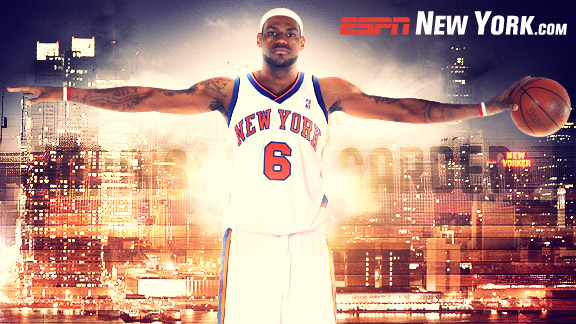
For three long, very long, very, very long years, New York Knicks fans have awaited the arrival of LeBron James, who has quickly become the team's savior even though there are still 45 days until he is a free agent. LeBron who didn't get to go through the college recruiting process, is getting his chance at being wooed now, and it's even better than college: there are millions of dollars involved (I guess he would have gotten both had he gone to USC).

The Knicks have been planning for this off-season for years now, making trades, and opening up cap space, in order to sign two of the big-name players in this year's free agent market, which is certainly enticing for LeBron. Every successful dynasty has had two star players; it's the formula for success. Think about it, Russell and Cousy; Magic and Kareem; Jordan and Pippen, and Shaq and Kobe. The idea that the Knicks could compliment LeBron with a star like Chris Bosh, Joe Johnson, Amar'e Stoudemire, or dare I say it Dwayne Wade, may be too much for LeBron to resist.

Once people have money, the next goal is power. LeBron is only 25 years old and is already set for life financially. Of course wherever he goes, he will be a very rich man, but the Knicks would probably be able to offer more money than any other team. That isn't the only reason LeBron is perfect for the Knicks. By going to New York, his fame skyrockets, and he quickly becomes even more recognizable than he already is, which is tough to imagine. He has the chance to be not only the Knicks' knight in shining armor, but also the hero in a city that loves its basketball. Sure, the advantages of playing in a big city as opposed to a smaller city aren't what they used to be, with every team getting television time and attention whether they're in a big market or middle America, but playing in the biggest city in the biggest arena in the world is tough to turn down. LeBron has the money, and New York would allow him to cement his legacy, if he's able to turn around a team that hasn't had a winning season since the 2000-01 season.

Of course, there is the big, and I mean big possibility that LeBron won't go to the Knicks. If they want to have a chance at LeBron, they'll need to sign another big name first, so LeBron isn't left leading another team all by himself. With a lot of teams contending for the star free agents like Dwayne Wade and Chris Bosh, it's not 100 percent that the Knicks will be able to land two big names, and if they can't land another superstar, and I mean SUPERstar, then there is no reason for LeBron to even consider New York.

Another problem, is that the team only has two starters from last year's team under contract in Danilo Gallinari and Wilson Chandler, and if they sign two big stars, will not have enough money to get depth on their bench, which could hurt them in the playoffs, the one thing that LeBron is looking to conquer. But, with the enticement of being able to rebuild a franchise, win the championships that would possibly cement his legacy as the best basketball player of all time, and re-invigorate what once was a basketball city on the biggest stage in the world in New York, LeBron will have a tough time turning down the Knicks, who I think is the front-runner at the moment in the chase for LeBron.

2. Cleveland Cavaliers

Even though for most speculators, the question is where will LeBron go next?, with the keyword being next, the Cavaliers still have a shot at bringing back their city's savior. They play in LeBron's hometown, and with reports that LeBron is fiercely loyal, he may feel badly about leaving. His departure would affect not only the Cavaliers, but also the entire city of Cleveland, which has grown just with LeBron's presence. If James leaves, the Cavaliers would lose a ton of revenue, and go back to being just another middle of the road team, with LeBron's absence always looming over them. The city and its economy would also go quickly into a downward spiral, as Cleveland will have much fewer visitors with LeBron's absence, its only big attraction being the Rock N Roll Hall of Fame.

But, LeBron has already put up with seven long seasons of losing in the playoffs, suffering incurred not to his own fault, but to the lack of a supporting cast. The idea of suffering even just for another year with a team that seems to forget how to play basketball once the playoffs start, probably hurts just thinking about for LeBron.

The supporting cast for Cleveland is still lacking, even after the Cavs have pulled all the strings. Shaq, Antawn Jamison, Mo Williams weren't enough to help LeBron get a ring, but don't be surprised if LeBron gives the Cavaliers a few more years in order to bring a championship to his hometown.

3. Chicago Bulls

This is a team that could pose a threat to the Knicks in the contest for LeBron. They play in a big city, they have young, proven talent, making the playoffs as an 8-seed this past season, and LeBron would probably be able to pick the team's next head coach.

The Bulls have a young star point guard in Derrick Rose, who is quickly becoming one of the best players in the league, and a trusty big man in Joakim Noah. They recently fired Vinny Del Negro, and with LeBron' friendship with Kentucky coach John Calipari, Derrick Rose having played for Calipari at Memphis, and Calipari admitting that he would listen to any offer from the NBA, it's possible that Calipari could be coaching the Bulls next year. The mix of being able to pick his own coach and play with a solid supporting cast, makes Chicago a contender for LeBron.

There is one problem, and one major problem at that. The Bulls had this guy back in the 90s named Michael Jordan, who won six championships with the team, and to whom LeBron is frequently compared to. If LeBron went to the Bulls the comparisons would get much worse; every single game and play that LeBron made, would be put under a magnifying glass, and there would be tremendous amounts of pressure to win. Could LeBron live up to the Jordan legacy? In my opinion, yes; I think when it's all said and done, LeBron will be the best basketball player of all time, but the real question is, does LeBron want to have to live up to MJ's legacy? The answer to that question is probably, no.

That is why the likely choice for Chicago here, is Dwayne Wade. Wade, a Chicago native, has very close ties with the city, and would make Chicago's back-court the best in the league, teaming up with Derrick Rose. If Chicago can't get LeBron, which I don't think they can, then Wade is the likely choice.

4. New Jersey Nets

The Nets are a bit of a wildcard team, a dark horse in the race for LeBron. One reason why the Nets aren't getting as much attention as the Knicks is because, well, it's New York vs. New Jersey, who do you think would win?

But even though the Nets and New Jersey are perpetually in the shadows of the Knicks and New York, there are a lot of reasons why the Nets would be a perfect fit for LeBron. Jay-Z is a part owner of the Nets, and one of LeBron's close friends. Plus, the Nets won't be playing in the Meadowlands for too much longer; the plan for the already delayed stadium in Brooklyn is to be finished and ready to move into by 2012. The idea of helping the Nets become the best team in New York, and possibly the league, would be exciting for James, especially with the young talent that they have in Brook Lopez, Devin Harris, and by this year's draft, most likely, John Wall.

Surely saying that the Nets will be championship, let alone playoff contenders within a few years might be an exaggeration, but that's certainly what new Nets majority owner Mikhail Prokhorov has in mind. The flashy Russian billionaire who bought the Nets this year, has big plans for the team. But taking a chance on a team that came in dead last in the league last year, despite their youth, may be moving backwards for LeBron, who I'm sure doesn't want to have to lead another hopeless team.

5. Miami Heat

The Heat could be a perfect fit for LeBron. They already have superstar Dwayne Wade, and at least enough of a supporting cast where LeBron and Wade would be able to win a few titles. Who knows, maybe even Pat Riley will come back and coach the Heat, just to entice Wade to stay and LeBron to come. Wade has been looking for the Heat to give him a supporting player, and LeBron has been looking for the same thing from the Cavaliers, and it's safe to say that Wade and LeBron would be much more than supporting players for one another.

The problem here is that I believe that Wade and LeBron are going to go in separate directions, with Wade going to the Bulls and LeBron going to, well, God knows where. It would be tough for any team to land that much star power in one off-season, and provide the boatloads of cash that both players are looking for, and rightfully deserve, no matter how much cap space that team has. Unless Wade and LeBron rig free agency and collaborate to join the same, there is little chance that the Heat would land them, and even then it's unlikely, as they would probably both rather play in New York, than the Heat if they did collaborate. Don't look for LeBron and Wade to be hanging out on South Beach in the near future.

It seems as if LeBron James has been around the league for all of eternity. The fact of the matter is though, is that he's only 25 years old, still two years younger than Michael Jordan when he won his first of six championships. LeBron still has the time to win some rings, but there is no time better than right now, and LeBron knows that better than anyone else. The past seven years, he has had the whole weight of not only a team, but a city, and a state on his back, his home state at that. Whether he wants to keep trying to bring a championship to his hometown, a city that hasn't seen a title in any major sport since 1964, is tough to tell, but having to carry the Cavs for even just another few years, would seem unbearable. That is why the team LeBron signs with, will need to show that they can win multiple titles with him there, either with the supporting cast that they already have, or by signing another big-name free agent.

The important thing to remember is that myself or any journalist, or analyst, or other common folk can spend all day and night crunching the numbers, analyzing each team's style of play, combined with cap space, and thousands of other factors to try and figure out where LeBron will be going this summer but, the fact of the matter is that there's no way of telling where he'll go until he actually makes the decision (Believe me, I fully realize the irony of this statement, after spending hours on an article doing just that). He can follow the money, or go where he thinks he can win or both, but for the next 44 days, 23 hours, 18 minutes and 54 seconds, all any of us can do is speculate, pure and simple.

But please LeBron, for the love of God, come to the Knicks.

Sunday, May 9, 2010

Sports and Politics: The Story of a Shaky Marriage


This past Wednesday, on Cinco De Mayo, the Phoenix Suns spoke out against the new immigration laws in Arizona, by sporting jerseys with Los Suns written on the front.

Suns owner Robert Sarver had the idea for the jerseys, and after getting unanimous support from the players, decided it would be a good idea to use them.

According to CNN.com, "under the [law], police would be required to question anyone they suspect of being undocumented. The [law] also targets those who hire illegal immigrant day laborers or knowingly transport them."

Sarver believes that the law is not "the right way to handle the immigration problem, Number 1. Number 2, as I read through the bill, it felt to me a little bit like it was mean-spirited, and I personally just don't agree with it."

When Tony Kornheiser asked Steve Nash what he thought about Arizona's new immigration law on ESPN's Pardon The Interruption yesterday, I couldn't help but sigh for what I expected to come. It was a valid question, considering the context in which it was asked. Steve Nash plays for the Phoenix Suns, and is a Canadian immigrant, but athletes, especially of his caliber, usually prefer to not take positions on such controversial issues, for marketing reasons. Understandably, most try not to alienate fans or potential fans by stating their views on big issues.

Still, the general public wants to hear athletes answer these questions, to prove that they can talk about more than box scores, and zone defenses. Like other high-profile athletes, I expected Nash to find a crafty way of answering the question, but not really answer the question, or just not comment at all.

I was wrong. He didn't even come close to dancing around the question; the first three words out of his mouth were "I'm against it." He went on to say "I think that this is a bill that really damages our civil liberties ... opens up the potential for racial profiling, racism ... it's a bad precedent to set for our young people, represents our state poorly, and hopefully it will change a lot in the coming weeks. We have to find a different way to combat the issues, and I think that this is the wrong way to go about it."

Certainly not your usual, "I don't feel comfortable answering that question." And good riddance. The idea that more publicly stated opinions leads to less sold jerseys is quickly being debunked by devout Christian Tim Tebow. Tebow spoke out on one of the most controversial issues, on one of the biggest stages in sports (abortion during the Super Bowl). And guess what? This past April, Tebow had the highest selling jersey in the NFL. And that's not just for rookies, that is the entire National Football League.

Then there's Twitter nation. Shaquille O'Neal and Chad Ochocinco, if anything have kept their jersey and marketing revenues up by expressing their views on social media sites like Twitter.

Speaking out means relevancy, and relevancy means more revenue.

But of course, money isn't everything. Some athletes have been politically and socially active for a while now, whether people like it or not.

Former Major League pitcher Curt Schilling is an avid Republican. He campaigned for Bush in 2004, and in 2008 did the same for McCain who he had worked with since 2000 on veterans issues. Rumors have constantly circled about a possible political career for Schilling, including this past year, in the special election for Ted Kennedy's Senate seat. He has never ruled out the possibility of a career in politics.

In the 2008 presidential election, athletes donated a total of $445,334, with 55.8% going to Obama and 44.2% going to McCain, despite the fact that Sports Illustrated reports that when it comes to voting, athletes are usually 50-50 between Democrats and Republicans.

The line between sports and politics is a shaky one, and sometimes it is tough to say when to cross it. Is it really appropriate for an industry that is for sheer entertainment to get involved in some of the hotter issues of the day? If any sporting event has the answer to that, it's the Olympics.

The Olympics have probably pushed sports and politics closer together than they have ever been. The 1980 and 1984 Summer Olympics held in Moscow and Los Angeles respectively were boycotted heavily, the American athletes refusing to go to the Soviet Union, and the Soviet athletes refusing to go to the U.S. during the Cold War.

The 2008 Summer Olympics also created a lot of buzz over political issues. Protests about China's control over Tibet, human rights (or lack thereof), censorship, and the massive amounts of air pollution, pushed the relationship between sports and politics to its breaking point. Many called for a boycott of the games, and even some athletes got involved in the protests.

When coming into Beijing, a group of American cyclists were wearing black masks, as to not breath in the polluted air. It is still contested as to whether these cyclists were just trying to stay in top physical shape for their races or if they were making a political statement, but either way the Chinese government took offense and the cyclists subsequently apologized, even though the masks had been distributed to all American athletes.

The Olympics, as a global sporting event is a great stage to address issues, some of them extremely important. So when given the global platform to speak on, it is acceptable and should be expected, that athletes speak out for what they believe in, especially in a place as controversial as China. The Olympics are one of the few times that global issues can be addressed without petty politics drawing a veil over the most serious issues. Even if it is athletes doing the talking, any attention that these issues get, especially on such a huge stage, is important.

The United States is not any different. Professional athletes should be allowed to express their political views freely without having to worry about losing fans or facing criticism for being some dumb jock. In a world with constant news coverage, and more exposure of national and global issues than ever before, it is important that professional athletes - all of whom have to serve as role models, whether they like it or not - take a stand for what they believe in.

What is most important is not that athletes speak up, but that the general public isn't solely swayed by the view of their favorite athletes. The main point of athletes speaking up should be to draw attention to certain issues, so that the fans research the issues for themselves and draw their own conclusions on the matter, not just go with what the athlete says.

So don't be surprised if you see guys like Favre, A-Rod or Kobe coming out on issues like gay marriage, health care, or stem cell research. It may just be the new fad.

Friday, May 7, 2010

Can Horse Racing and Boxing Be Saved?


This past Saturday night, Floyd Mayweather, Jr. easily defeated 38 year old Shane Mosley in a 12 round unanimous decision. In terms of pound-for-pound fighting, coming into the bout, Mayweather was ranked second and Mosley was ranked third in the welterweight division, according to ESPN.com. On the surface it certainly seemed like a pretty good fight. And it was for the first two rounds, as the quick Mosley was giving "Money" Mayweather a run for his money. But Mosley's lead disintegrated quickly as Mayweather began to land his shots. By the end of the fight, Mayweather had landed 208 compared to Mosley's 92.

The fact that a 2 vs. 3 fight was as lopsided as this one was, just goes to show that the only acceptable fight, the only fight that even has the possibility to save the sport of boxing from falling into oblivion is No. 1 Welterweight Champion of the World Manny Pacquiao vs. No. 2 Floyd Mayweather.

Back in March, Pacquiao had a lopsided fight of his own, going against Joshua Clottey, at Dallas Cowboys Stadium in front of 50,994 spectators. Clottey, although not as popular or as skilled as Mosley, had a 35-3 record going into the fight, and was one of the better kept secrets in boxing, at least until millions saw him lose big time to Pacquiao, who landed 246 of his 1,231 punches on the overwhelmed Clottey, who landed 108 of his only 399 punches.

So now we're back to Square 1. When will Pacquiao and Mayweather, undoubtedly the two best fighters in the world, face off in what would be one of the biggest fights in decades? It's the same question people not only in the world of boxing, but in the world of sports, were asking everyday months ago, and after the Mayweather-Mosley fight it's the question everyone is back to asking.

Mayweather refuses to fight until Pacquiao agrees to undergoing Olympic-style drug testing. This type of testing calls for random blood and urine tests before and after the fight, instead of the usual testing which would only test urine for banned substances before and after the fight. Pacquiao was originally only willing to have his blood taken 24 days or more before the fight, because he claimed if their blood is taken "close to the match, it will be a disadvantage for me because I'm smaller and he's big."

Many boxing insiders say that the fight is bound to happen no matter what, as there is too much money on the table for anyone in their right mind to pass up. If the fight actually occurs it could be the fight that would save the dying sport of boxing.

Another historically American sport is undergoing many of the same problems that boxing is going through right now: horse racing.

Horse racing, like boxing, was extremely popular throughout the 20th century, and for many of the same reasons. Like the huge fights in boxing, the huge races in horse racing would take place only a few times a year. In between the competitors would have large layoffs, or would compete in smaller races or fights. The big competitions however, were perfect for gambling, which had a resurgence following the Great Depression, with its' legalization used as a way to help the economy. Las Vegas was also growing with gambling, and quickly became a popular spot for big fights.

Technological advances also helped the two sports. With the invention of the radio and television, the big horse races and premier fights became some of the biggest events of the year.

Then there were the personalities and the flash that both sports had that fit so well with the pop-culture filled periods of the 20th century. Periods like the Roaring Twenties and and youth-filled Sixties, were periods where boxing and horse racing experienced huge growth. Boxing brought characters like Muhammad Ali, Joe Frazier, and Don King, as well as some fun, yet hate-filled rivalries. With the idea of the pop culture celebrity coming about, the large personalities and egos that came with the gambling and flashy atmospheres of horse racing and boxing were perfect for the American audience.

The focus on the individual, whether human or horse, went hand in hand with a rise in American individualism as a result of a concurrent rise in Soviet socialism. As silly as it sounds, individual sports like boxing and horse racing had more capitalist tendencies than team sports did.

So what happened? Boxing these days seems an afterthought to many, as does horse racing. The main reason for this is probably the rarity of these events. In a world of constant sports coverage, big horse races and fights are put on the backburner to sports that can provide constant news with games every day or every week for most of the year. Since we don't hear about boxing and horse racing every day, we just naturally push them aside.

Then there's the lack of identification many feel with the sports. Boxing, especially the heavyweight class, is dominated by fighters from Eastern European and Latin American countries, with solid Americans far and few in between. Horse racing is seen as too old school, dominated by old, wealthy white guys who own or train the horses. It almost has too much tradition for the masses to be able to relate to it.

Then there's the change in the gambling culture. With online gambling on the rise, fewer people are leaving their homes to go to the track. Then there's the idea of having to pay-per-view for boxing. With so many sporting events available on cable television, a lot of people don't find it worth it to pay extra to watch sporting events.

So will boxing and horse racing ever come back to prominence? If the Pacquiao-Mayweather, Jr. bout ends up happening, it would probably be the most watched pay-per-view title fight in the history of boxing. This fight also has a lot of similarities to the great Ali-Frazier fights. Today, Oscar De La Hoya and Bob Arum are ruthlessly promoting the big fight, like Don King had done in the past.

After Mayweather's defeat of Mosley, De La Hoya called Mayweather, "the king of the world now ... the best by far" and said that he should be the one "to dictate [the drug testing]."

On the other side there's Bob Arum, Pacquiao's promoter. Arum's Top Rank Boxing, promoted Mayweather from 1996 - 2006, but the two had a fallout, after Mayweather accused Arum of shortchanging him on money he was owed for fights, while Arum claimed that the only reason he didn't pay was because Mayweather owed him millions of dollars. Since then, Arum has accused Mayweather of ducking big fights, saying that Mayweather has "always been a coward because he's afraid to face somebody who could beat him."

Then there are the fighters themselves. Mayweather is easily comparable to Ali. He's constantly running his mouth, and he always backs it up, just like Ali did and once said in one of his best quotes, "it's not bragging if you can back it up." Both Mayweather and Ali were criticized for their outspokenness often, especially when Ali would frequently claim he was "the greatest," and Mayweather claimed he was "better than Muhammad Ali [and] Sugar Ray Robinson." Both were flashy, outspoken, unbeatable fighters. The only difference is that Mayweather in notorious for staying away from big fights; Ali wasn't afraid of anyone.

Then there's Pacquiao, a Filipino, campaigning to become a Filipino congressman this summer. He's so beloved in the Philippines, that it is tough to predict whether the Filipino people will vote for him, or purposefully vote for his competitors so that he continues to box. Pacquiao is largely viewed as the best pound-for-pound fighter in boxing today. His overall record is 51-3-2, but unlike Mayweather, has gone up against the best of the best.

The Mayweather-Pacquiao fight may draw a lot of attention to the sport of boxing, but it's unlikely that the hype will last more than a few months. People will turn back to their usual everyday sports, and forget that the fight and boxing ever existed. There aren't enough good American fighters, or even good non-American fighters for that matter, and therefore not enough good fights to watch. With all of the coverage and media that sports get in the modern world, boxing occurs too infrequently to be a major sport.

Horse racing faces the same problem. There are too few races that matter, and it's much tougher to follow a single horse, than it is to follow a team. No horse has won the Triple Crown since 1978, when Affirmed won the Big Three races. Horse racing also isn't a sport made for television, with only two minute races, and then a wait of 30 minutes until the next race. The only way to enjoy horse racing is going to the track, and with people being able to follow other sports more closely, going to a baseball game or watching other sports from home sounds a lot better than going to a race track.

There may be a solution for the "Sport of Kings" though. With track-casinos sprouting up everywhere, the future of horse racing could be bright, as the large middle-class audience that horse racing has not been able to attract, may start flocking to local racetracks.

Either way, if Calvin Borel and Super Saver pull off the Triple Crown, there would be zero to little effect on horse racing. People would not start paying attention to small horse races, and by the time the Triple Crown came around next year, people would have already forgotten or stopped caring about Super Saver or any other Triple Crown winner. With the nature of the sport not being suited for television - unless they are Triple Crown races - it will be impossible for horse racing to catch up with major sports, or even survive as a sport.

Horse racing and boxing are two of the greatest sports in American history. They are deep parts of the fabric of American society, and were two of the greatest sports in the American 20th century.

Although horse racing and boxing are two of my favorite sports to watch, even I don't pay attention to them that often. With major sports like baseball, basketball, football, hockey, and all of their college equivalents coming one after the other all year round, and producing news for constant sports coverage by the media, it's impossible to get overly excited about sports that you hear nothing about.

Sure, maybe the Triple Crown races, and the Pacquiao-Mayweather fight (if it even happens) may get a good deal of coverage and viewers. But it's not like these sports cease to exist after these events, until the next big fight or race comes along. There are sporting venues, trainers, staff, etc. that need to be paid for by the smaller races and fights, that are needed to build competitors for the big events. Since the United States isn't at all interested in these small events, and probably never will be, it seems as if horse racing and boxing are sports that are doomed to fail.

Tuesday, May 4, 2010

Players Play, Spectators Spectate


My beef this week is with 17 year old Steve Consalvi, (we'll call him Dummy) who ran onto the field during a Phillies game and those criticizing police for tasing him when he did so.

Last night, Dummy decided it would be a good idea to run onto the field. Dummy, who will be attending Penn State University next year (or was supposed to be attending Penn State University pending the university's view of how his being charged as a juvenile for resisting arrest, disorderly conduct and defiant trespass should play into his admission) wasn't on any drugs, and hadn't even had any alcohol. In fact, he even called his dad asking permission to run on the field, to which the dad replied that it wasn't the best of ideas, maybe shrugging it off as a practical joke.

Well, Dummy wasn't joking, he hopped over the fence and ran onto the field, and a few seconds later found himself lying on the ground after being tased by the police chasing after him.

99.99% of the time, people running on the field only desire to make drunken idiots out of themselves, and get roaring cheers from the crowd. But then there is that 0.01% of the time when the person running on the field is out there to do damage to a player or whoever they can get to.

Back in 1993, Monica Seles, ranked No. 1 in women's tennis at the time, was playing a small match in Hamburg, when lunatic Gunter Parche ran from the crowd and onto the court during a break and stabbed Seles between the shoulder blades. Seles was only 19, but she had already won two Grand Slam titles, and was on her way to becoming one of the best tennis players of all time.

But now because of Parche, we'll never know what could have been. Seles returned to the game in August 1995, and despite winning her first tournament back at the Canadian Open, was never close to the same player she was before the stabbing. Her career and life were ruined.

Then there was the Tom Gamboa incident. The 54 year old Gamboa was doing his job, coaching first base for the Kansas City Royals on September 19, 2002 in a game against the White Sox. That's when 34 year old William Ligue, Jr. and his 15 year old son, ran bare-chested onto the field and attacked Gamboa, who never saw it coming, as his back was to the stands when they attacked him. Thankfully, the Royals ran out of the dugout and took down the attackers before Gamboa had any major injuries. It could have been much worse though, as a pocketknife was found on the ground where the attack had taken place. Aaron Rowand, then a White Sox outfielder, said he saw the pocketknife fall out of one of the attacker's pockets, during the incident.

Sure, when a 17 year old kid runs on the field, everyone just thinks that he's drunk or trying to get some attention. And that's exactly what Dummy was doing; just having a good time. But why take any precautions? What he is doing is not only illegal, but also dangerous to the players just doing their jobs. Why risk a player's safety for some idiot who decided that instead of just being a spectator, he had to grab some attention. The players should play, and the spectators should spectate, nothing more, nothing less.

After the tasing, there were some mixed feelings on whether or not the police had used excessive force in bringing Dummy down. The usual method for bringing people like Dummy down is a tackle or when the crowd is really lucky, a clothesline. But tasing allows the police to not have to get close to the spectator-turned-participant, and still be able to bring him down effectively. Plus, I'm not sure how many of you have seen this infamous video (http://www.youtube.com/watch?v=6bVa6jn4rpE) but being tased certainly isn't bundles of fun. It actually seems like an extremely painful experience. But when someone breaks the law and has the possibility of hurting an innocent person or player, then I'd rather have the criminal who may or may not have malicious intent brought down by any means necessary than to see an innocent person doing their job get hurt, or have to fear getting hurt. Maybe if people see how painful tasers can be, then they would think twice before running onto the field.

So sorry if I'm being a bit of a buzzkill, but is it really that hard to stay in your seat at an enjoyable sporting event? Sure, incidents like Monica Seles' stabbing or even Tom Gamboa's attack rarely happen, but why put innocent people at risk for the sake of criminals. If all of the drunks, streakers, loonies and foolish 17 year old kids were tased whenever they ran onto the field, we would most likely be able to avoid tragedies like the one that ruined Seles' career and scarred Gamboa. Don't protect the fools who know what will happen and what they will do when they run onto the field, protect the players who don't.