Sunday, October 31, 2010

Culture, Not Rules, of Football Must Change to Protect Players


My beef today is with both the NFL's executives in their handling of big hits this season and the players’ reaction to the new rules about hitting.

Two weekends ago, big helmet-to-helmet hits resulted in seven players leaving games with head injuries. For years now, these hits have been glorified and promoted by everyone who watches football. When the media isn’t showing touchdowns, interceptions or long field goals in highlights, they’re showing big hits. The conventional thinking on defense is that in order to get recognized you have to be able to knock a guy out.

This type of thinking was exemplified two weeks ago in the Steelers’ game against the Browns by Steelers’ linebacker James Harrison. In that game, Harrison knocked not one, but two players out of the game (Josh Cribbs and Mohamed Massaquoi) with big helmet-to-helmet hits. Although the hit on Cribbs was deemed legal, the shot that knocked Massaquoi out of the game earned Harrison a $75,000 fine from the league office. In response, Harrison contemplated retirement for a day, concerned that he couldn’t “actually play by NFL rules and still be effective.”

Here’s the thing: Big hits do not make a defensive player more effective — tackles do. If Harrison does not think he can tackle someone without taking their head off, then he shouldn’t be playing in the National Football League. Harrison’s not alone, though; in this day and age, defensive players rarely wrap up players, instead choosing to just run into them, in hopes that they will go down.

Proper tackling involves wrapping up a guy with your arms. James Harrison did not wrap one guy up when he made his hits. Patriots’ safety Brandon Meriweather was fined $50,000 for a helmet-to-helmet hit on Ravens’ tight-end Todd Heap and Falcons’ cornerback Dunta Robinson was also fined $50,000 for a hit on Eagles’ wide receiver DeSean Jackson that left both Robinson and Jackson concussed. These aren’t tackles — they are egregious and unnecessary hits.

Many defensive players have been crying about these new rules punishing their big hits, arguing that the NFL is looking out too much for offensive players. Dolphins’ linebacker Channing Crowder stated, “They want to save the receivers and quarterbacks because they sell all the jerseys. They don’t give a damn at all about defensive players.”

In addition to the anger about the NFL protecting only players that are marketable, many are angry because they believe they’ll be forced to play the game with more restrictions than offensive players. Buccaneers’ defensive end Stylez White said, “You’re trying to switch up how people hit. Well then, how about telling running backs not to run hard.”

These feelings of under-appreciation by the defense are understandable, but it is still clear that defensive players do not realize that tackling does not necessarily mean making big hits. In addition to his remark about marketable offensive players, Channing Crowder later went on to say, “They give me a helmet, I’m going to use it.” James Harrison said, “I don’t want to injure anybody. ... I try to hurt people.” A helmet is for safety, not for use as a weapon, and the point of a tackle is not to hurt the opposing player — it’s to bring him down. The proven way to do that is to wrap a guy up, not lead with your helmet. Although some players argue that it will be tougher to separate the player from the ball this way, the fact of the matter is players putting their shoulders into the ball while wrapping a ballcarrier up will be more likely to force a fumble than banging helmets.

Football is a violent sport, but one thing that it should not be is a dirty sport. If all football is today is guys taking cheap shots at one another, then players may want to re-evaluate the reckless abandon with which they play the game.

Instead of the players taking action, the NFL is doing so. Big fines were handed out to guys who made big hits. Some of these fines were questionable though, mostly because the NFL’s handling of the situation has been questionable itself. Just a few weeks ago, players were being praised for big hits, and now they are being punished for them. The NFL is trying to do the right thing in protecting its work force, but it is going about it in the wrong way.

First, there is what the NFL deems punishable in terms of hits, defined as “head shots” and “egregious and elevated dangerous hits,” according to Ray Anderson, the NFL’s executive Vice President of football operations. Banning head shots is understandable and the rule’s wording is clear, but the phrase “egregious and elevated dangerous hits” is about as vague as you can get. Instead of putting in legislation that clearly defines what is and what is not allowed, the NFL instead plans to play it by ear and fine and punish players when it sees fit. The problem with this is that players have been participating in hard-hitting football for years now, and the NFL has been profiting off of it, and even encouraging it through videos such as “The NFL’s Greatest Hits.” Now, all of a sudden the NFL is going to ban these hard hits? Players may be overreacting to how difficult it will be to make good quality tackles instead of the big hits they usually make, but that does not mean that the NFL should have the right to immediately start penalizing and suspending guys on an ad hoc basis for hits that were legal and commended just a few weeks ago.

Instead of immediate action, the NFL should instead undertake the task of changing the atmosphere of football, by first starting with the coaches, from pee wee football all the way to the NFL.

Guys hit the way they do because that’s the way they have been told to hit since they were young. The NFL and its Players Association have to make everyone aware of what kind of terrible effects theses type of hits can have on players in addition to giving strict guidelines as to what is and what is not acceptable. Although Commissioner Roger Goodell has to give the process time, both coaches and players also have to be involved in helping to change the game and the way it is played. This way, the progress made will actually be sustainable.

The faster defensive players realize that excessive hits and rule-breaking violence need to be taken out of the game, the better. That said, the NFL can’t just pick and choose which hits they will suspend and fine players for and which they won’t. There needs to be strict guidelines put in place by the NFL. This isn’t a problem that can be fixed by just slapping a couple of fines on players; the atmosphere of the game has to be changed for good, and that’s the responsibility of the executives, the coaches and the players.

Originally appeared in The Hoya Friday 10/29/10

Wednesday, October 27, 2010

Work In Progress


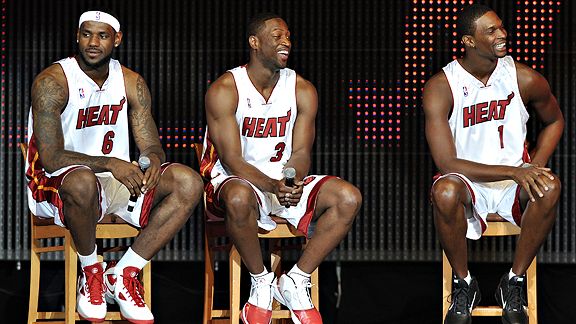
The Big Three won last night on NBA Opening Night, but probably not The Big Three that you're thinking of. No, not LeBron James, Dwayne Wade and Chris Bosh, instead, Boston's Three Party, Paul Pierce, Ray Allen and Kevin Garnett got their first W. But the most prolific player of the game was not one of those six mentioned above. The game's most valuable player instead, was Celtics point guard Rajon Rondo, who showed everyone last night that he was the heart and soul of this Celtics team with his astounding 17 assists.

The hype was there, in fact, it was the most anticipated opening game in NBA history, but the talent wasn't. In the first quarter, arguably the two best teams in the Eastern Conference played like they were back in middle school, with the Celtics only up 15-9 after the first 12 minutes of play. Rondo was the only player who showed any promise at all in the first quarter and even the first half, serving as the engine that kept the Celtics offense moving. Shaquille O'Neal also launched a Shaq Attack early, throwing down two slams in the first quarter to help get the Celts started and even made two consecutive free throws late in the second quarter, a rarity for the big man.

The Heat on the other hand didn't have anything going for them early. They came out looking as if they expected everything to gel right away but didn't know how to make it work yet. Dwyane Wade was playing for the first time since he pulled his hamstring in the Heat's first preseason game and it showed as he shot a dismal 4-for-16 from the field. He played very erratically, not exactly knowing where to be on the floor with LeBron taking over the role of floor general that he has played his entire career. He and LeBron both struggled communicating however, combining for 14 turnovers over the course of the game.

Although it looked as if LeBron had made a huge mistake by taking his talents to South Beach in the first half, that quickly changed once the second half began. With Wade and Bosh on the bench, LeBron was able to get back to the way he played in Cleveland and keep the ball in his hands, which is how he seems to be most effective. It's great that he scored 31 points that way, but the negative side is that he may not be able to play well off of the ball. Throughout his basketball career, James has always been the guy with the ball and the de facto point guard, and now with two other stars who are used to having the ball in their hands as well, it'll be interesting to see how LeBron James is able to play the supporting role during the game, for the first time in his life.

Then there's Chris Bosh. Where does he fit in in all of this? He quietly went 3 for 11 on the night, but managed to pull down eight rebounds. Bosh, a finesse big man, will have a much tougher time fitting in on this team than anyone else. He has about as little power as a power forward can have, and it's even worse when he finds himself playing center. That means that he needs the ball in his hands to be effective more than a usual, powerful big man does, which won't happen with only one ball on the floor and LeBron and D-Wade being the two best players on the team. He'll need to be pulling down even more offensive rebounds than he does now if he wants to score some points. Another problem is that Bosh isn't strong enough to go up against the likes of Dwight Howard and Shaquille O'Neal, the two big men on the other two best teams in the east. Bosh is going from being the best player on a terrible team to being the third best player on what is supposed to be one of the most talented teams ever assembled, and it's going to be interesting to see how he'll handle the change; if it doesn't go well, the Heat may have to change their nickname from the "Big Three" to the "Big Two and The Other Guy."

Then there's the team playing as a unit. Last night, when all three players were on the floor at the same time, it looked like they were each taking turns making plays. One possession it would be LeBron's turn to do something, the next it would be Wade's, then Bosh's then again and again. In order for this team to be effective, they're going to have to learn how to move off the ball, something that none of them have much experience with. But that comes with time and experience as a team, and there's still a lot of both to be had.

The Heat aren't going 82-0, not this year at least. As LeBron James said somewhat arrogantly, "we all know Rome wasn't built in one day." A bit cocky, but he's probably right, this experiment will work out. There's too much talent and young talent at that, for it not to work. It'll take time for everyone to get used to playing with one another, but team chemistry will develop. There's still 81 games left, and in this team's first game against the reigning Eastern Conference champs, and almost reigning NBA champs - albeit that the Celtics did not play as such in this game - they only lost by eight points. Considering the circumstances and the way the played in the first half, the Heat should almost be happy with the outcome; eight points can come very easily as Knicks fans know (http://www.youtube.com/watch?v=nieBAq8FQYE&feature=related, seeing that never gets easier). It'll be interesting to see how everything comes into place for this Heat squad, but one thing's for sure, it will come into place, or else someone's gonna have some explaining to do.

Wednesday, October 6, 2010

Title IX’s Beneficial Intent Becoming Discriminatory


My beef this week is with the discrimination against males in intercollegiate athletics that Title IX has caused.

No, this isn’t an anti-feminist stand; Title IX has done great, necessary things for women’s sports. The problem is, this success has created inequality — exactly what Title IX is supposed to be getting rid of.

Most people are very familiar with Title IX, but few are familiar with its history. Title IX was enacted on June 23, 1972, and is part of the Education Amendments of 1972. The original law states that, “No person in the United States shall, on the basis of sex, be excluded from participation in, be denied the benefits of, or be subjected to discrimination under any education program or activity receiving Federal financial assistance.”

There is never any mention of sports in this original statute. Only after the original statute and after the Department of Health, Education and Welfare got involved did intercollegiate sports become affected by Title IX.

A few years after its inception, under the Carter administration in 1979, the Department of Health, Education and Welfare further specified what they would recognize as compliance with the law. This test is made up of three parts (only one of which schools have to follow), and is often referred to as the proportionality test. The test states that schools in compliance must either “have the same proportion of girls in sports as enrolled in school; [be] expanding the opportunities for girls in sports; or [be] satisfying the entire interest of girls to participate in sports.”

Since the last two are vague, to be safe, many schools just follow the first rule of compliance and try to keep the proportion of female athletes equal to the proportion of female students at the school.

The proportionality test seemed like a great idea at the time. The late 1970s and early ’80s saw equal enrollment between males and females, but that didn’t last as women have since outnumbered men. According to the American Council on Education, females have consistently made up around 57 percent of enrollments at American colleges since 2000. That means that under the proportionality rule, 57 percent of college athletes should be female.

Doesn’t sound very equal to me.

Many critics of Title IX propose that the number of men’s and women’s sports and athletes be based on the interest of each sex to participate in varsity athletics. They argue that interest should be based on participation in specific sports on the club and intramural level, as well as the number of students interested in trying out and the level of interest among high schoolers who hope to participate on collegiate varsity teams. One problem with this is that it would result in more male than female sports teams. In 2009-2010, according to the National Federation of State High Schools, 4,455,740 boys participated in high school athletics as opposed to 3,172,637 girls.

There’s an even bigger discrepancy concerning participation in intramural sports in college where men outnumber women four to one. Although the difference in the number of male and female athletes seems large, it’s a lot smaller than what it has been in decades past, showing that Title IX is doing its job in promoting female participation in athletics. Basing the number of sports teams per gender off of interest would stunt this growth too much for it to be a viable option.

Many proponents of Title IX point to the gargantuan amount of funding that goes to football and men’s basketball teams as the main problem for a lack of funding for small-scale men’s sports, not Title IX.

The first problem with this argument is that the reason most men’s sports are being cut is not because of a lack of funding, but because of the need to comply with Title IX’s proportionality test.

One great example of this is the Marquette University wrestling team. In 2001, the team was dropped despite the fact that it was completely financed by alumni and other program supporters. It wasn’t even competing for funding with a football team, something Marquette still doesn’t have. The only reason was to comply with Title IX.

The majority of men’s teams being cut are usually ones with few if any scholarships, ones funded without the school’s money (or very little of it) and ones that have no big-time football or basketball team to compete with for money.

The second problem with the argument citing high funding for football and men’s basketball as the main problem for the destruction of small-scale men’s sports is that in cutting down funding for these revenue-producing sports, the institution is biting the hand that feeds it and cutting down on the profits that these sports make — profits used to fund small-scale sports. If a school was to cut down funding for popular sports, the talent that these teams would be able to recruit would go down dramatically.

If recruiting plummets, the team falls on hard times and interest among fans drops, resulting in a drop of revenue and profits that the team produces. Since those profits are usually used to help finance other sports, a decrease in them would result in smaller sports getting cut. More funding for football and men’s basketball teams therefore, doesn’t cut down the funding for other men’s sports — it increases it.

The solution to the problem of Title IX is quite simple. Instead of proportionality, colleges should have to have an equal amount of male and female teams and/or athletes. That way everyone gets an equal shot at participating. Another good idea that’s been bounced around is discounting students ages 25 and older in proportionality tests. This age group, which makes up around 40 percent of the undergraduate population, will most likely not be partaking in varsity sports, and therefore shouldn’t be counted in these tests. This would be extremely important, as the American Council of Education’s report “Gender Equity in Higher Education: 2010” showed that female college students ages 25 and over outnumber male college students of the same age group, two to one. Implementing either or both of the systems would be a great way to reform Title IX.

Title IX has done great things and is still vital to increasing female interest in sports to this day. But advocates of Title IX are as stubborn as ever, unwilling to budge in fear that all of the battles they have won over the years will be for naught if they give in even the slightest bit.

The fact of that matter is though, that reform is necessary, and if Title IX advocates truly believed in equality — as they claim — they’d be open to it.

Originally appeared in The Hoya on 10/1/2010