Monday, April 25, 2011

The Quarterback Controversy


Meet Blaine Gabbert. He apparently has all the "intangibles" that it takes to be an NFL quarterback; he stands at 6'5" weighs 235 pounds and has a 10 inch hand span. As a result of these "intangibles," Gabbert might just be the first quarterback and possibly the first pick overall taken in this year's NFL Draft.

Wait, when you say Blaine Gabbert, you mean Mizzou's old QB? The guy who only threw for 16 TDs last year (tied for 59th best among quarterbacks), compared to his 9 interceptions (tied for 58th most thrown) and finished 21st in passing yards, with 3,186 of them? That guy is going to be selected early? But he's tall and his hands are big, that's good enough right?

I have never understood all of the hype surrounding guys like Blaine Gabbert, who impress people because they look like NFL quarterbacks. People seem to magically forget that in football you don't just have to look the part, you have to play it as well.

If you look at the starting QBs in the NFL today, there really is no exact description of what they look like, how they got to where they were, where they were drafted and what their college stats are like. There is the golden boy Peyton Manning, the guy that has all the intangibles, was successful in college, got picked high in the draft and has been successful in the NFL. Then, there are the Tom Bradys, guys who have all the intangibles, don't have a great college career, get drafted in the late rounds, and nevertheless become a superstar in the NFL. Then, there are guys like Drew Brees, who might not even be six feet tall, had great success in college, were looked over in the draft because of their size and have still been great in the NFL.

Of course, there's the saying that success at the college level does not always translate into success at the pro level, and that is right for the most part. It's right in that college and pro football are two totally different games, which sometimes require different types of quarterbacks. But if success at the college level does not translate into success at the pro level, wouldn't it follow that mediocrity at the college level would translate into even less success at the pro level? How can someone play well against the best football players in the world, when they struggle against college football players?

Now maybe Blaine Gabbert might just got on to be a great quarterback; as of right now it's too early to look him over entirely just yet. But, it's clear that the majority of today's quarterbacks that are successful in the NFL, were also successful in college. Out of the top 10 passing leaders from last year (based on yards), only Tom Brady and arguably Matt Schaub got less attention and played worse in college than Gabbert. Of course, like Gabbert both of them had outstanding physical size, and as a result (in addition to some other key factors) are making it in the NFL. But that's the minority; most guys not only have to have the size, they also have success in all levels of football.

Blaine Gabbert did not ask to become this year's hype machine, and he has to be happy that he's been hyped up so much. Come Thursday, he will almost certainly be one of the first 10 names called, if not the first five or the first, making millions more than he ever though he would make just a few months ago. Who knows, maybe Blaine Gabbert will prove himself just like Jay Cutler or Ben Roethlisberger, guys who had all the intangibles but not necessarily the stats or the greatest college competition. But then again, there are the Ryan Leafs, the Matt Leinarts, the never-ending list of guys who seemingly had all the intangibles to be an NFL quarterback and never made it. It’s not a revolutionary idea. If (in general of course) only the top middle school athletes make the best high school athletes and only the top high school athletes make good college athletes would it not then follow, that only the best college athletes make good professional athletes? Of course, there are always exceptions (which Blaine Gabbert could be), but they are called exceptions for a reason, because they do not follow the usual rule.

Saturday, April 9, 2011

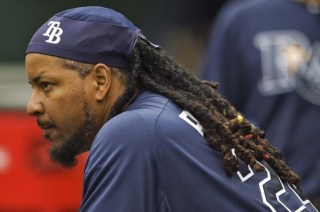
What Does Manny Being Manny Mean Now?


Manny Being Manny. It means a lot of things, and one more thing as of two days ago. It means being crazy, a well-known dread-locked goofball, best remembered for being part of the self-proclaimed Red Sox Idiot Teams of the 2000s. It means being one of the best hitters in baseball history; during his 19 year career, he had 2,574 hits, 555 home runs, a .585 career slugging percentage, and a .996 OPS. The only other players in baseball history to at least match him in all of those stats: Babe Ruth and Barry Bonds. And speaking of Barry Bonds, let's move on to what the third and most recent part of what Manny Being Manny means: steroid use.

It is impossible to know just how long Manny has been a steroid user. The most likely scenario is that he was using PEDs throughout his career. The main evidence for this was his appearance on a list of players who had tested positive for PEDs in 2003. That and the fact that he has been officially caught using PEDs twice, with both of those failed tests came within the past two years, is good enough evidence for me. The first came in 2009, during his time with the Dodgers, for which he served a 50 game suspension. Now, just a few games into the season with his new team, the Tampa Bay Rays, he's been caught again, and instead of serving the 100 game suspension, the 38 year old veteran has decided it was best to just hang up the cleats for good after a 19 year career.

And down goes another baseball hero from the decade. Another would-be sure-fire Hall of Famer that might just end up losing his spot because of two failed tests late in his career, when he was already seemingly bound for Cooperstown.

What a great time for this to happen to Manny though. Because of the fact that the news broke during the Barry Bonds trial, he's flying under the radar in terms of steroid stories. But even though it's being somewhat overlooked now, Manny's steroid use is going to be hot news at least when his name is first on the ballot for the Hall. After failing not one but two tests and reportedly a test several years earlier, how can Manny not be one of the poster-boys for steroids?

Manny's primary legacy can no longer be that of the legendary hitter whose bat as well as free-spirit made even Yankee fans want to like him. If people are going to remember guys like Bonds, McGwire, and Sosa for their steroid use, it's important to remember guys like Manny for their steroid use as well. Of course, I am not in any way glad that Ramirez's reputation was tarnished, in fact out of all the power hitters from the Steroid Era, I think Ramirez was the one that everyone wanted to be roid-free because of his affability, and as a result was the one guy people assumed could not have been taking steroids. However, he can't be let off of the hook because of his care-free demeanor and continued success after the proclaimed Steroid Era, when it was clear he was still taking roids not only during but also after the Era.

Of course, there is no definitive way to tell whether Manny was using steroids in his prime or only whether he only used them recently to get his power and bat going again, but what would it say about us if we were only concerned with juicers that used steroids during their primes instead of toward the end of their careers? Steroids are bad, period; there are no exceptions to the rule where one guy's steroid use should be different than another guy's. We can forgive and possibly forget, but if we want to do that then we need to do so with all steroid users as a matter of fairness, there should be no picking and choosing. Either you forgive them all, or you punish them all. But with Manny Being Manny, I don't know if he'll care either way.

Friday, April 8, 2011

Barry Bonds Will Always Be On Trial


As we move along into the second year of this new decade, it's interesting to reflect on what history will have to say about the decade that just passed, the first of not only a new century but a new millennium. Well, sports-wise, it was anything but fantastic. Looking back on the 2000s, it's tough for the front page headline not to be performance-enhancing drugs and how they tarnished not only our national pastime, but even some of our Olympic heroes, especially in track and field. It's tough to think that this won't be seen as the age of cheating, and the age of the asterisk.

PEDs have tarnished the reputations of the greatest athletes during this era; you know the list, Barry Bonds, A-Rod, Marion Jones, Mark McGwire, Floyd Landis, Sammy Sosa, and possibly even Roger Clemens and Lance Armstrong. So how will players involved in baseball, cycling and track and field especially, escape the shadow that steroids are sure to cast over them a few years from now when most will just be distant memories?

Fans are very forgiving of off-field transgressions, but when problems occur on the field, they're not quick to forget, unless athletes themselves are quick to apologize - see Andy Pettitte and even Jason Giambi. For athletes like Barry Bonds however, who fight the allegations consistently, the cheater label sticks on to them like white on rice. And that's why today, sports fans are chuckling at the fact that Bonds has a perjury trial, seven years after he told a grand jury he never knowingly took PEDs.

The sad part is, Bonds isn't even contesting the fact that he took PEDs anymore - it's been made clear by both sides in the case, that he has used steroids such as the cream and the clear - he's only contesting the accusation that he took them knowingly, which is what the perjury case is in fact about.

The case would be made easier if Bonds' former personal trainer Greg Anderson agreed to testify, which he has consistently refused to do, despite the fact that he had to serve about two weeks year in prison because of his refusal. That's not all Anderson has served time for however; back in 2005 he served three months for money laundering and guess what else ... steroid distribution. It's certainly not explicit evidence of Bonds' guilt, but it's tough to believe that Bonds would stick with Anderson if he too was not using the steroids. He certainly did not stick with Anderson during the first days of the trial; reports say that both times Anderson walked by Barry in court today, Bonds averted his eyes.

At 6:51 p.m. yesterday, Bonds' fate was handed over to a jury, which will continue deliberations on Monday. People such as his former business manager, former personal shopper, former girlfriend/mistress, and other ballplayers that Anderson gave drugs to, have all testified against Bonds, but the prosecution has reportedly been weak up until these past few days, while Bonds' defense has been impressive throughout. From a legal standpoint, it's been noted that while the prosecution had tons of witnesses, they may have not had enough actual evidence to prove Barry Bonds actually knew he was taking steroids when he told a grand jury he did not. The prosecutors have appealed to common sense, and have essentially brought the stories of all the witnesses together, but it is tough to tell whether they have actually tied the knot between them with tangible-enough evidence. So while it's common sense to presume Bonds knew what he was doing as everyone else his trainer gave steroids to did, it does not necessarily mean there is enough evidence to prove it.

It has taken a long time to get to this point, and even this trial will not be the end for mention of PED use in sports. Every year around Hall of Fame voting time, the debate will begin whether to elect players who took steroids like Barry Bonds to the Hall or not. So, Bonds not only faces the jury for his perjury trial now, but hereafter he will face a jury of sportswriters debating his Hall of Fame status and a jury of baseball fans, wondering what exactly to make of his legacy.